

If the excitation of a synchronous motor is increased above normal, what is its effect on the maximum active (real) power developed by the motor?
 Answer & step-by-step solution

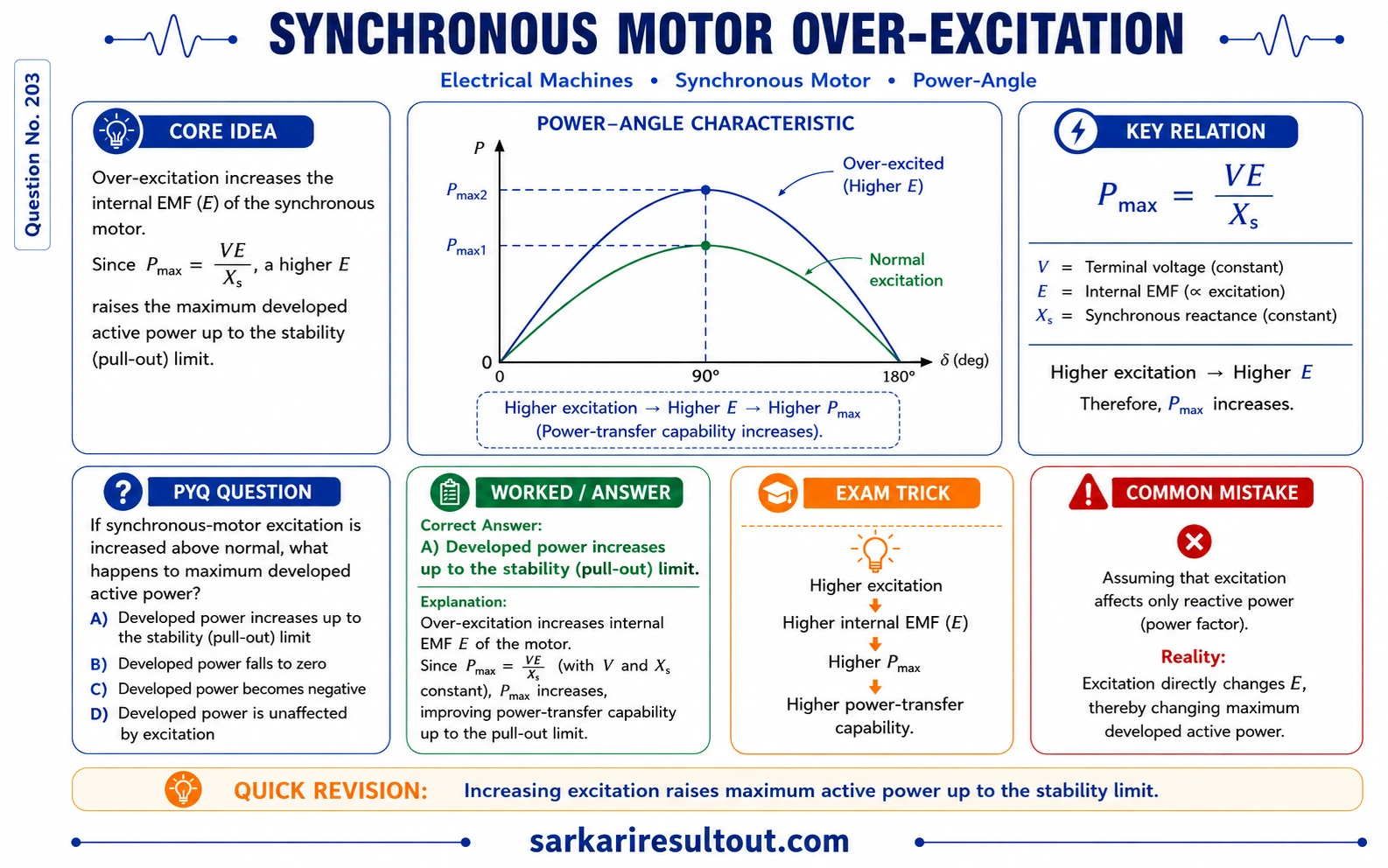
A — It increases up to the stability (pull-out) limit. With V and Xs constant, P = (VE/Xs) sinδ, so raising excitation E raises Pmax = VE/Xs.
Detailed solution (in the paper’s original language)
સમજૂતી
Cylindrical synchronous machine માટે terminal voltage અને synchronous reactance constant માનીએ તો power-angle relation P = (VE/X_s) sinδ છે.
Field excitation વધારવાથી internal EMF E વધે છે. તેથી theoretical maximum developed/transferable active power P_max = VE/X_s stability અથવા pull-out limit સુધી વધે છે.
મુખ્ય ખ્યાલ
Excitation internal EMF E બદલે છે અને તેથી maximum power-angle capability સીધી બદલાય છે.
સૂત્ર
P = (VE/Xs) sinδ; δ = 90° પર Pmax = VE/Xs.
પરીક્ષા મુદ્દો
Fixed load પર operating power અને machine ની maximum power capability અલગ રાખો.
ઝડપી ટ્રિક
Higher excitation → higher E → higher P_max.
બીજા વિકલ્પો ખોટા કેમ છે
Active-power capability excitationથી ક્યારેય બદલાતી નથી એવો વિકલ્પ power-angle equation માં E ની ભૂમિકા અવગણે છે.
સામાન્ય ભૂલ
Excitation ફક્ત reactive power/power factor ને જ અસર કરે છે અને power-angle limit ને નહીં એવું માનવું.
यदि सिंक्रोनस मोटर का उत्तेजन (excitation) सामान्य से बढ़ाया जाए, तो मोटर द्वारा विकसित अधिकतम सक्रिय (वास्तविक) शक्ति पर क्या प्रभाव पड़ता है?
उत्तर और चरणबद्ध हल
A — यह स्थिरता (पुल-आउट) सीमा तक बढ़ती है। V और Xs स्थिर हों तो P = (VE/Xs) sinδ, इसलिए उत्तेजन E बढ़ाने पर Pmax = VE/Xs बढ़ता है।
विस्तृत हल (मूल भाषा में)
સમજૂતી
Cylindrical synchronous machine માટે terminal voltage અને synchronous reactance constant માનીએ તો power-angle relation P = (VE/X_s) sinδ છે.
Field excitation વધારવાથી internal EMF E વધે છે. તેથી theoretical maximum developed/transferable active power P_max = VE/X_s stability અથવા pull-out limit સુધી વધે છે.
મુખ્ય ખ્યાલ
Excitation internal EMF E બદલે છે અને તેથી maximum power-angle capability સીધી બદલાય છે.
સૂત્ર
P = (VE/Xs) sinδ; δ = 90° પર Pmax = VE/Xs.
પરીક્ષા મુદ્દો
Fixed load પર operating power અને machine ની maximum power capability અલગ રાખો.
ઝડપી ટ્રિક
Higher excitation → higher E → higher P_max.
બીજા વિકલ્પો ખોટા કેમ છે
Active-power capability excitationથી ક્યારેય બદલાતી નથી એવો વિકલ્પ power-angle equation માં E ની ભૂમિકા અવગણે છે.
સામાન્ય ભૂલ
Excitation ફક્ત reactive power/power factor ને જ અસર કરે છે અને power-angle limit ને નહીં એવું માનવું.
જો સિંક્રનસ મોટરનું એક્સાઈટેશન (excitation) સામાન્ય કરતાં વધારવામાં આવે, તો મોટર દ્વારા વિકસિત થતા (developed) મહત્તમ એક્ટિવ (રિયલ) પાવર પર તેની શું અસર થાય છે?
જવાબ અને પગલાવાર ઉકેલ
Cylindrical synchronous machine માટે terminal voltage અને synchronous reactance constant માનીએ તો power-angle relation P = (VE/X_s) sinδ છે.
સમજૂતી
Cylindrical synchronous machine માટે terminal voltage અને synchronous reactance constant માનીએ તો power-angle relation P = (VE/X_s) sinδ છે.
Field excitation વધારવાથી internal EMF E વધે છે. તેથી theoretical maximum developed/transferable active power P_max = VE/X_s stability અથવા pull-out limit સુધી વધે છે.
મુખ્ય ખ્યાલ
Excitation internal EMF E બદલે છે અને તેથી maximum power-angle capability સીધી બદલાય છે.
સૂત્ર
P = (VE/Xs) sinδ; δ = 90° પર Pmax = VE/Xs.
પરીક્ષા મુદ્દો
Fixed load પર operating power અને machine ની maximum power capability અલગ રાખો.
ઝડપી ટ્રિક
Higher excitation → higher E → higher P_max.
બીજા વિકલ્પો ખોટા કેમ છે
Active-power capability excitationથી ક્યારેય બદલાતી નથી એવો વિકલ્પ power-angle equation માં E ની ભૂમિકા અવગણે છે.
સામાન્ય ભૂલ
Excitation ફક્ત reactive power/power factor ને જ અસર કરે છે અને power-angle limit ને નહીં એવું માનવું.

 More Synchronous Machines questions