

To prevent an alternator from operating in motor mode due to prime mover failure, a/an __________ relay is used.
 Answer & step-by-step solution

A — Reverse Power relay. It detects active power flowing from the energized system into the alternator when the prime mover can no longer supply sufficient mechanical power.
Reverse Power Relay: Protection Against Generator Motoring
A — Reverse Power relay. It detects active power flowing from the energized system into the alternator when the prime mover can no longer supply sufficient mechanical power.
Why an alternator starts motoring
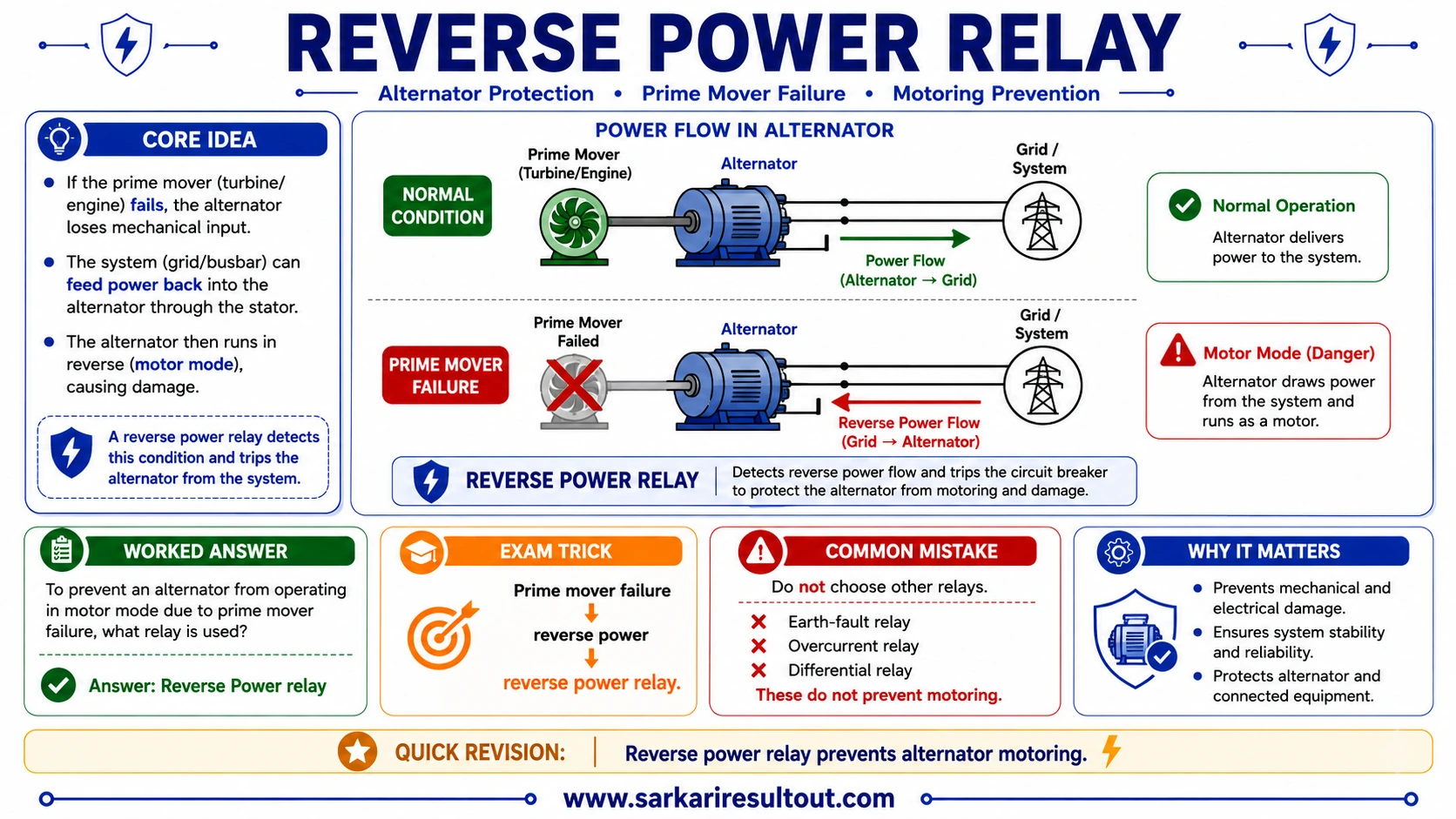
During generation, a turbine or engine supplies mechanical power to the alternator, and the alternator delivers electrical power to the bus. If this mechanical input fails while the machine remains connected to an energized bus, the system can drive the machine instead. The alternator then absorbs active power and operates as a synchronous motor.
The critical condition is loss of mechanical input while an external electrical supply remains connected. Prime-mover failure in an isolated generator without such a supply does not automatically produce sustained motoring.
How reverse power protection responds
A reverse power relay determines the direction of active power from voltage and current measurements. When reverse active power exceeds its setting for the configured delay, it initiates the trip logic to disconnect the generator. This limits prolonged motoring and possible damage to the prime mover.
The relay does not need to detect a short-circuit or a very large current. Motoring power may be a small fraction of rated generator power, which is why ordinary overcurrent protection is not the appropriate answer.
Useful Formula
With export taken as positive: P_export > 0 during generation; P_export < 0 during motoring.
Why the Other Options Are Not the Answer
- B — Earth Fault: responds to a fault involving earth; it does not specifically detect reversal of active power.
- C — Overcurrent: responds to excessive current magnitude; motoring may occur without a large overcurrent.
- D — Differential: compares currents at the boundaries of a protected zone to detect internal faults, not normal-through-current motoring.
Remember for the Exam
Reverse power protection is commonly associated with ANSI device function 32. Focus on the direction of real power, not the direction of reactive power.
Common mistake: Do not interpret “reverse power” as reversed phase sequence, reverse rotor rotation or reactive-power reversal.
Reference: SEL: Generator Motoring Protection – Are You Protected?
Quick Trick
Prime mover fails + live bus remains connected → power flows into generator → reverse power relay.
Common Mistake
Do not interpret “reverse power” as reversed phase sequence, reverse rotor rotation or reactive-power reversal.

प्राइम मूवर विफल होने के कारण अल्टरनेटर को मोटर मोड में चलने से रोकने के लिए __________ रिले उपयोग होता है।
उत्तर और चरणबद्ध हल
A — रिवर्स पावर रिले। जब प्राइम मूवर पर्याप्त यांत्रिक शक्ति नहीं दे पाता, तो सक्रिय शक्ति प्रणाली से अल्टरनेटर में बहने लगती है; यह रिले उसे पहचानकर मशीन को अलग कर देता है।
विस्तृत हल (मूल भाषा में)
Reverse Power Relay: Protection Against Generator Motoring
A — Reverse Power relay. It detects active power flowing from the energized system into the alternator when the prime mover can no longer supply sufficient mechanical power.
Why an alternator starts motoring
During generation, a turbine or engine supplies mechanical power to the alternator, and the alternator delivers electrical power to the bus. If this mechanical input fails while the machine remains connected to an energized bus, the system can drive the machine instead. The alternator then absorbs active power and operates as a synchronous motor.
The critical condition is loss of mechanical input while an external electrical supply remains connected. Prime-mover failure in an isolated generator without such a supply does not automatically produce sustained motoring.
How reverse power protection responds
A reverse power relay determines the direction of active power from voltage and current measurements. When reverse active power exceeds its setting for the configured delay, it initiates the trip logic to disconnect the generator. This limits prolonged motoring and possible damage to the prime mover.
The relay does not need to detect a short-circuit or a very large current. Motoring power may be a small fraction of rated generator power, which is why ordinary overcurrent protection is not the appropriate answer.
Useful Formula
With export taken as positive: P_export > 0 during generation; P_export < 0 during motoring.
Why the Other Options Are Not the Answer
- B — Earth Fault: responds to a fault involving earth; it does not specifically detect reversal of active power.
- C — Overcurrent: responds to excessive current magnitude; motoring may occur without a large overcurrent.
- D — Differential: compares currents at the boundaries of a protected zone to detect internal faults, not normal-through-current motoring.
Remember for the Exam
Reverse power protection is commonly associated with ANSI device function 32. Focus on the direction of real power, not the direction of reactive power.
Common mistake: Do not interpret “reverse power” as reversed phase sequence, reverse rotor rotation or reactive-power reversal.
Reference: SEL: Generator Motoring Protection – Are You Protected?
Quick Trick
Prime mover fails + live bus remains connected → power flows into generator → reverse power relay.
Common Mistake
Do not interpret “reverse power” as reversed phase sequence, reverse rotor rotation or reactive-power reversal.
પ્રાઇમ મૂવર નિષ્ફળ જવાને કારણે ઓલ્ટરનેટરને મોટર મોડમાં ચાલતું અટકાવવા __________ રિલે વપરાય છે.
જવાબ અને પગલાવાર ઉકેલ
A — રિવર્સ પાવર રિલે. જ્યારે પ્રાઇમ મૂવર પૂરતો યાંત્રિક પાવર આપી શકતું નથી, ત્યારે સક્રિય પાવર પ્રણાલીમાંથી ઓલ્ટરનેટરમાં વહેવા લાગે છે; આ રિલે તેને ઓળખીને મશીનને અલગ કરે છે.
વિગતવાર ઉકેલ (મૂળ ભાષામાં)
Reverse Power Relay: Protection Against Generator Motoring
A — Reverse Power relay. It detects active power flowing from the energized system into the alternator when the prime mover can no longer supply sufficient mechanical power.
Why an alternator starts motoring
During generation, a turbine or engine supplies mechanical power to the alternator, and the alternator delivers electrical power to the bus. If this mechanical input fails while the machine remains connected to an energized bus, the system can drive the machine instead. The alternator then absorbs active power and operates as a synchronous motor.
The critical condition is loss of mechanical input while an external electrical supply remains connected. Prime-mover failure in an isolated generator without such a supply does not automatically produce sustained motoring.
How reverse power protection responds
A reverse power relay determines the direction of active power from voltage and current measurements. When reverse active power exceeds its setting for the configured delay, it initiates the trip logic to disconnect the generator. This limits prolonged motoring and possible damage to the prime mover.
The relay does not need to detect a short-circuit or a very large current. Motoring power may be a small fraction of rated generator power, which is why ordinary overcurrent protection is not the appropriate answer.
Useful Formula
With export taken as positive: P_export > 0 during generation; P_export < 0 during motoring.
Why the Other Options Are Not the Answer
- B — Earth Fault: responds to a fault involving earth; it does not specifically detect reversal of active power.
- C — Overcurrent: responds to excessive current magnitude; motoring may occur without a large overcurrent.
- D — Differential: compares currents at the boundaries of a protected zone to detect internal faults, not normal-through-current motoring.
Remember for the Exam
Reverse power protection is commonly associated with ANSI device function 32. Focus on the direction of real power, not the direction of reactive power.
Common mistake: Do not interpret “reverse power” as reversed phase sequence, reverse rotor rotation or reactive-power reversal.
Reference: SEL: Generator Motoring Protection – Are You Protected?
Quick Trick
Prime mover fails + live bus remains connected → power flows into generator → reverse power relay.
Common Mistake
Do not interpret “reverse power” as reversed phase sequence, reverse rotor rotation or reactive-power reversal.
 More Generator & Transformer Protection questions