

A 4-bit ripple counter consists of flip-flops, where each have a propagation delay from clock to Q output of 15 ns. For the counter to recycle from 1111 to 0000, it takes a total of ________
 Answer & step-by-step solution

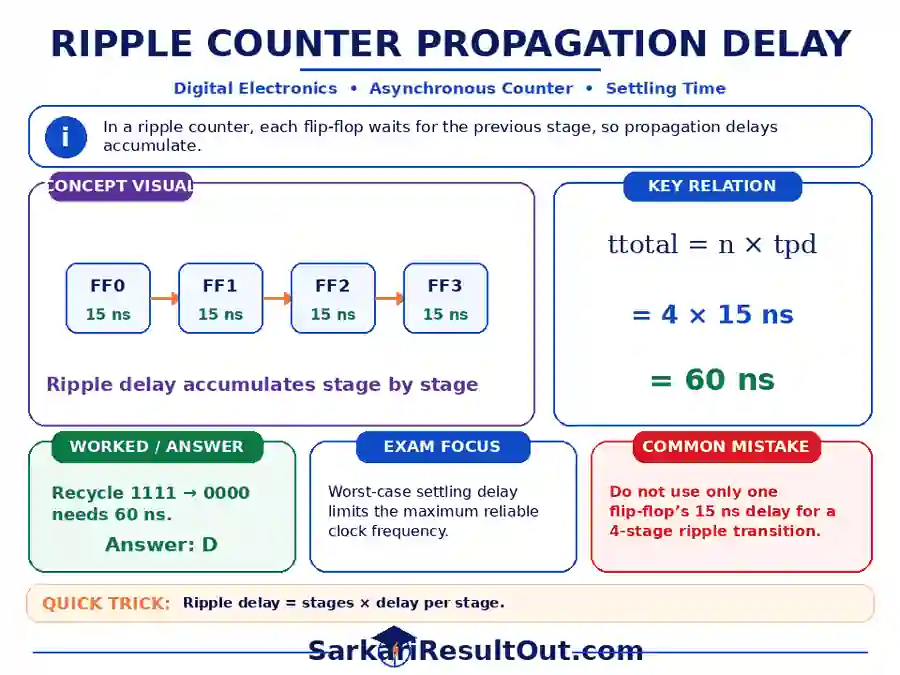
In an asynchronous ripple counter, the transition must propagate through successive flip-flops. With four flip-flops each having 15 ns clock-to-Q delay, the worst-case settling time is 4×15 = 60 ns.
Concept & Reasoning
Unlike a synchronous counter, a ripple counter does not switch every flip-flop from a common clock edge. One stage's output triggers the next, so delays accumulate. The 1111→0000 recycle can require the change to ripple through all four stages, giving the worst-case propagation delay.
How to Solve It in the Exam
Ripple counter worst-case delay = number of stages × delay per stage.
Important Exam Point
This cumulative delay limits the maximum reliable clock frequency.
Quick Trick
Ripple counter worst-case delay = number of stages × delay per stage.
Common Mistake
Using only one flip-flop's 15 ns delay as the counter settling time.

एक 4-बिट रिपल काउंटर में फ्लिप-फ्लॉप हैं, जिनमें प्रत्येक का क्लॉक से Q आउटपुट तक प्रसार विलंब 15 ns है। काउंटर को 1111 से 0000 पर लौटने में कुल ________ लगता है।
उत्तर और चरणबद्ध हल
असिंक्रोनस रिपल काउंटर में परिवर्तन क्रमिक फ्लिप-फ्लॉप से होकर गुजरता है। चार फ्लिप-फ्लॉप, प्रत्येक 15 ns विलंब के साथ, सबसे खराब स्थिति का सेटलिंग समय 4×15 = 60 ns है।
विस्तृत हल (मूल भाषा में)
Concept & Reasoning
Unlike a synchronous counter, a ripple counter does not switch every flip-flop from a common clock edge. One stage's output triggers the next, so delays accumulate. The 1111→0000 recycle can require the change to ripple through all four stages, giving the worst-case propagation delay.
How to Solve It in the Exam
Ripple counter worst-case delay = number of stages × delay per stage.
Important Exam Point
This cumulative delay limits the maximum reliable clock frequency.
Quick Trick
Ripple counter worst-case delay = number of stages × delay per stage.
Common Mistake
Using only one flip-flop's 15 ns delay as the counter settling time.
એક 4-બિટ રિપલ કાઉન્ટરમાં ફ્લિપ-ફ્લોપ છે, જે દરેકનો ક્લોકથી Q આઉટપુટ સુધીનો પ્રસરણ વિલંબ 15 ns છે. કાઉન્ટરને 1111 થી 0000 પર પાછા ફરવામાં કુલ ________ લાગે છે.
જવાબ અને પગલાવાર ઉકેલ
અસિંક્રોનસ રિપલ કાઉન્ટરમાં ફેરફાર ક્રમિક ફ્લિપ-ફ્લોપમાંથી પસાર થાય છે. ચાર ફ્લિપ-ફ્લોપ, દરેક 15 ns વિલંબ સાથે, સૌથી ખરાબ સ્થિતિનો સેટલિંગ સમય 4×15 = 60 ns છે.
વિગતવાર ઉકેલ (મૂળ ભાષામાં)
Concept & Reasoning
Unlike a synchronous counter, a ripple counter does not switch every flip-flop from a common clock edge. One stage's output triggers the next, so delays accumulate. The 1111→0000 recycle can require the change to ripple through all four stages, giving the worst-case propagation delay.
How to Solve It in the Exam
Ripple counter worst-case delay = number of stages × delay per stage.
Important Exam Point
This cumulative delay limits the maximum reliable clock frequency.
Quick Trick
Ripple counter worst-case delay = number of stages × delay per stage.
Common Mistake
Using only one flip-flop's 15 ns delay as the counter settling time.
 More Sequential Circuits questions