

Damper windings in alternators help prevent which operational issue during sudden load changes?
 Answer & step-by-step solution

C — Hunting. Damper windings reduce the rotor oscillations that follow a sudden load change by producing a torque that opposes those oscillations.
Why Damper Windings Prevent Hunting in Alternators
C — Hunting. Damper windings reduce the rotor oscillations that follow a sudden load change by producing a torque that opposes those oscillations.
What is hunting?
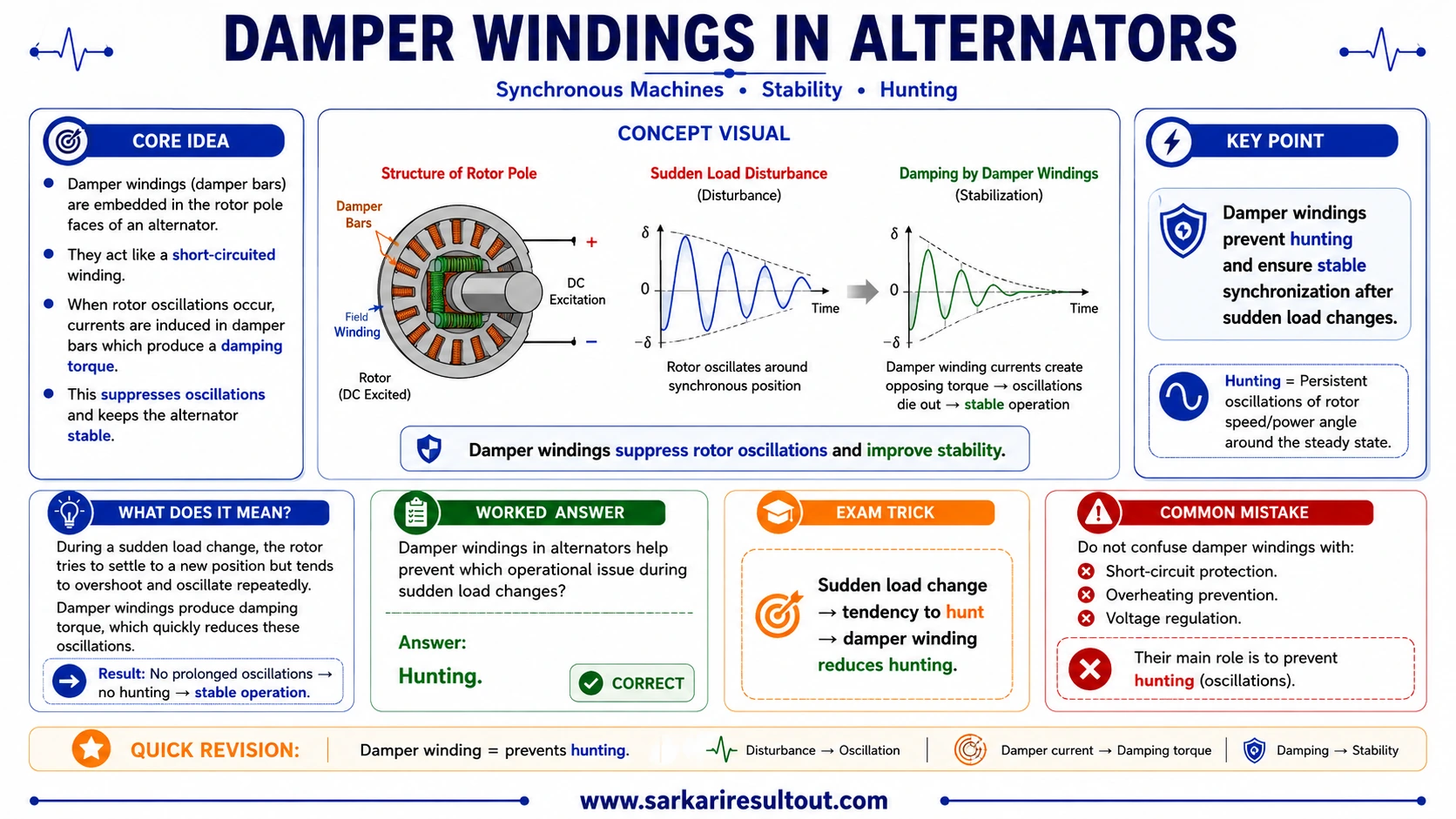
Hunting is the repeated swinging of a synchronous machine’s rotor about its new equilibrium position. When the electrical load changes suddenly, electromagnetic torque changes before the rotor can settle. Because the rotating assembly has inertia, the rotor may overshoot its new position and swing back and forth. The rotor angle oscillates, with brief speed deviations around synchronous speed.
How the damper winding works
In a typical salient-pole machine, conducting bars in the rotor pole faces are short-circuited at their ends. During hunting, relative motion develops between these bars and the rotating magnetic field. This induces currents in the bars.
By Lenz’s law, the resulting electromagnetic torque opposes the relative motion: it retards a rotor that momentarily moves ahead and assists one that falls behind. Oscillatory energy is dissipated as heat, so the swings gradually die out.
What happens during steady operation?
Under ideal balanced steady operation, the rotor and the fundamental rotating field move together at synchronous speed. There is no relative motion between them, so this field induces no damper current. The damping action becomes useful when a disturbance produces relative motion.
Why the Other Options Are Not the Answer
- A — Short-circuit: a fault cleared by suitable relays and circuit breakers; damper bars are not fault-interruption devices.
- B — Overheating: thermal protection and cooling address excessive temperature. Damper currents themselves produce some heat.
- D — Voltage drop: excitation control and voltage regulation address terminal-voltage changes; suppression of rotor oscillations is the purpose tested here.
Remember for the Exam
Link hunting with rotor-angle oscillations. In synchronous motors, damper windings can also provide starting torque; this question concerns an alternator after a load disturbance.
Common mistake: Do not confuse damping torque with synchronizing torque: synchronizing torque tends to restore rotor position, while damping torque reduces oscillation.
Quick Trick
Sudden load change → rotor swings → induced damper current → opposing torque → reduced hunting.
Common Mistake
Do not confuse damping torque with synchronizing torque: synchronizing torque tends to restore rotor position, while damping torque reduces oscillation.

अचानक लोड परिवर्तन के दौरान ऑल्टरनेटर में डैम्पर वाइंडिंग किस संचालन समस्या को रोकने में मदद करती है?
उत्तर और चरणबद्ध हल
C — हंटिंग। डैम्पर वाइंडिंग अचानक लोड परिवर्तन के बाद रोटर दोलनों का विरोध करने वाला टॉर्क उत्पन्न कर उन्हें कम करती है।
विस्तृत हल (मूल भाषा में)
Why Damper Windings Prevent Hunting in Alternators
C — Hunting. Damper windings reduce the rotor oscillations that follow a sudden load change by producing a torque that opposes those oscillations.
What is hunting?
Hunting is the repeated swinging of a synchronous machine’s rotor about its new equilibrium position. When the electrical load changes suddenly, electromagnetic torque changes before the rotor can settle. Because the rotating assembly has inertia, the rotor may overshoot its new position and swing back and forth. The rotor angle oscillates, with brief speed deviations around synchronous speed.
How the damper winding works
In a typical salient-pole machine, conducting bars in the rotor pole faces are short-circuited at their ends. During hunting, relative motion develops between these bars and the rotating magnetic field. This induces currents in the bars.
By Lenz’s law, the resulting electromagnetic torque opposes the relative motion: it retards a rotor that momentarily moves ahead and assists one that falls behind. Oscillatory energy is dissipated as heat, so the swings gradually die out.
What happens during steady operation?
Under ideal balanced steady operation, the rotor and the fundamental rotating field move together at synchronous speed. There is no relative motion between them, so this field induces no damper current. The damping action becomes useful when a disturbance produces relative motion.
Why the Other Options Are Not the Answer
- A — Short-circuit: a fault cleared by suitable relays and circuit breakers; damper bars are not fault-interruption devices.
- B — Overheating: thermal protection and cooling address excessive temperature. Damper currents themselves produce some heat.
- D — Voltage drop: excitation control and voltage regulation address terminal-voltage changes; suppression of rotor oscillations is the purpose tested here.
Remember for the Exam
Link hunting with rotor-angle oscillations. In synchronous motors, damper windings can also provide starting torque; this question concerns an alternator after a load disturbance.
Common mistake: Do not confuse damping torque with synchronizing torque: synchronizing torque tends to restore rotor position, while damping torque reduces oscillation.
Quick Trick
Sudden load change → rotor swings → induced damper current → opposing torque → reduced hunting.
Common Mistake
Do not confuse damping torque with synchronizing torque: synchronizing torque tends to restore rotor position, while damping torque reduces oscillation.
અચાનક લોડ ફેરફાર દરમિયાન ઓલ્ટરનેટરમાં ડેમ્પર વાઇન્ડિંગ કઈ કામગીરી સમસ્યા અટકાવવામાં મદદ કરે છે?
જવાબ અને પગલાવાર ઉકેલ
C — હન્ટિંગ. ડેમ્પર વાઇન્ડિંગ અચાનક લોડ ફેરફાર પછીના રોટર દોલનોનો વિરોધ કરતો ટોર્ક ઉત્પન્ન કરી તેમને ઘટાડે છે.
વિગતવાર ઉકેલ (મૂળ ભાષામાં)
Why Damper Windings Prevent Hunting in Alternators
C — Hunting. Damper windings reduce the rotor oscillations that follow a sudden load change by producing a torque that opposes those oscillations.
What is hunting?
Hunting is the repeated swinging of a synchronous machine’s rotor about its new equilibrium position. When the electrical load changes suddenly, electromagnetic torque changes before the rotor can settle. Because the rotating assembly has inertia, the rotor may overshoot its new position and swing back and forth. The rotor angle oscillates, with brief speed deviations around synchronous speed.
How the damper winding works
In a typical salient-pole machine, conducting bars in the rotor pole faces are short-circuited at their ends. During hunting, relative motion develops between these bars and the rotating magnetic field. This induces currents in the bars.
By Lenz’s law, the resulting electromagnetic torque opposes the relative motion: it retards a rotor that momentarily moves ahead and assists one that falls behind. Oscillatory energy is dissipated as heat, so the swings gradually die out.
What happens during steady operation?
Under ideal balanced steady operation, the rotor and the fundamental rotating field move together at synchronous speed. There is no relative motion between them, so this field induces no damper current. The damping action becomes useful when a disturbance produces relative motion.
Why the Other Options Are Not the Answer
- A — Short-circuit: a fault cleared by suitable relays and circuit breakers; damper bars are not fault-interruption devices.
- B — Overheating: thermal protection and cooling address excessive temperature. Damper currents themselves produce some heat.
- D — Voltage drop: excitation control and voltage regulation address terminal-voltage changes; suppression of rotor oscillations is the purpose tested here.
Remember for the Exam
Link hunting with rotor-angle oscillations. In synchronous motors, damper windings can also provide starting torque; this question concerns an alternator after a load disturbance.
Common mistake: Do not confuse damping torque with synchronizing torque: synchronizing torque tends to restore rotor position, while damping torque reduces oscillation.
Quick Trick
Sudden load change → rotor swings → induced damper current → opposing torque → reduced hunting.
Common Mistake
Do not confuse damping torque with synchronizing torque: synchronizing torque tends to restore rotor position, while damping torque reduces oscillation.
 More Synchronous Machines questions