

A Variable Air Volume (VAV) system in HVAC is designed to
 Answer & step-by-step solution

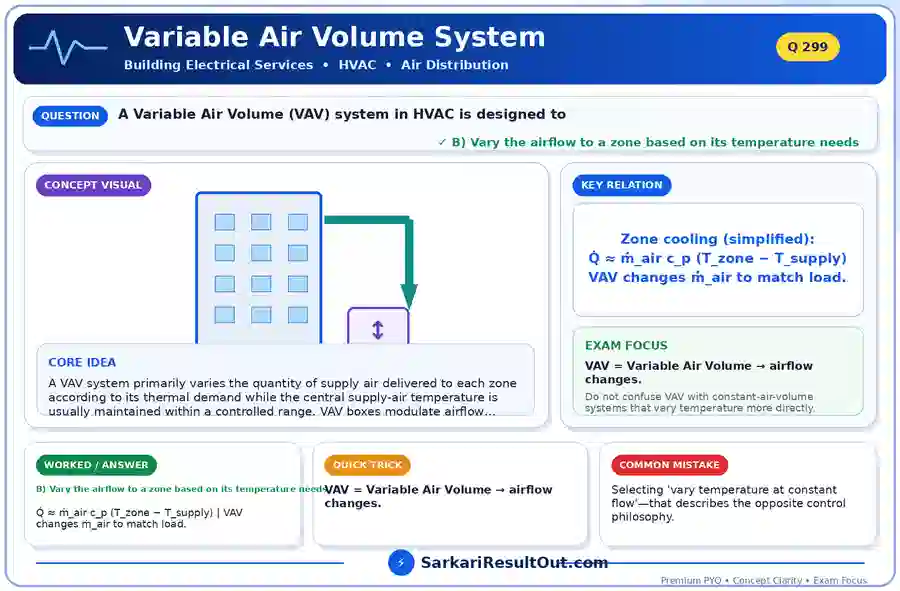
A VAV system primarily varies the quantity of supply air delivered to each zone according to its thermal demand while the central supply-air temperature is usually maintained within a controlled range. VAV boxes modulate airflow using dampers/controls.
Concept & Reasoning
When zone cooling demand falls, the VAV terminal reduces airflow; when demand rises, it opens to supply more air. This reduces fan energy compared with constant-volume systems, especially when a variable-speed supply fan tracks duct static pressure. Some VAV terminals may include reheat for minimum-flow/temperature control.
How to Solve It in the Exam
VAV = Variable Air Volume → airflow changes.
Important Exam Point
Do not confuse VAV with constant-air-volume systems that vary temperature more directly.
Quick Trick
VAV = Variable Air Volume → airflow changes.
Common Mistake
Selecting 'vary temperature at constant flow'—that describes the opposite control philosophy.

HVAC में वेरिएबल एयर वॉल्यूम (VAV) प्रणाली __________ के लिए डिज़ाइन की जाती है
उत्तर और चरणबद्ध हल
B — क्षेत्र की तापीय माँग के अनुसार वायु प्रवाह बदलना। VAV में केंद्रीय आपूर्ति-वायु तापमान लगभग स्थिर रहता है और प्रत्येक ज़ोन का VAV बॉक्स डैम्पर से वायु की मात्रा नियंत्रित करता है।
विस्तृत हल (मूल भाषा में)
Concept & Reasoning
When zone cooling demand falls, the VAV terminal reduces airflow; when demand rises, it opens to supply more air. This reduces fan energy compared with constant-volume systems, especially when a variable-speed supply fan tracks duct static pressure. Some VAV terminals may include reheat for minimum-flow/temperature control.
How to Solve It in the Exam
VAV = Variable Air Volume → airflow changes.
Important Exam Point
Do not confuse VAV with constant-air-volume systems that vary temperature more directly.
Quick Trick
VAV = Variable Air Volume → airflow changes.
Common Mistake
Selecting 'vary temperature at constant flow'—that describes the opposite control philosophy.
HVACમાં વેરિએબલ એર વોલ્યુમ (VAV) પ્રણાલી __________ માટે ડિઝાઇન કરવામાં આવે છે
જવાબ અને પગલાવાર ઉકેલ
B — વિસ્તારની તાપીય માંગ મુજબ હવા પ્રવાહ બદલવો. VAVમાં કેન્દ્રીય પુરવઠા-હવાનું તાપમાન લગભગ અચળ રહે છે અને દરેક ઝોનનો VAV બોક્સ ડેમ્પરથી હવાનું પ્રમાણ નિયંત્રિત કરે છે.
વિગતવાર ઉકેલ (મૂળ ભાષામાં)
Concept & Reasoning
When zone cooling demand falls, the VAV terminal reduces airflow; when demand rises, it opens to supply more air. This reduces fan energy compared with constant-volume systems, especially when a variable-speed supply fan tracks duct static pressure. Some VAV terminals may include reheat for minimum-flow/temperature control.
How to Solve It in the Exam
VAV = Variable Air Volume → airflow changes.
Important Exam Point
Do not confuse VAV with constant-air-volume systems that vary temperature more directly.
Quick Trick
VAV = Variable Air Volume → airflow changes.
Common Mistake
Selecting 'vary temperature at constant flow'—that describes the opposite control philosophy.
 More HVAC questions