

When is x(t) said to be non-periodic signal?
 Answer & step-by-step solution

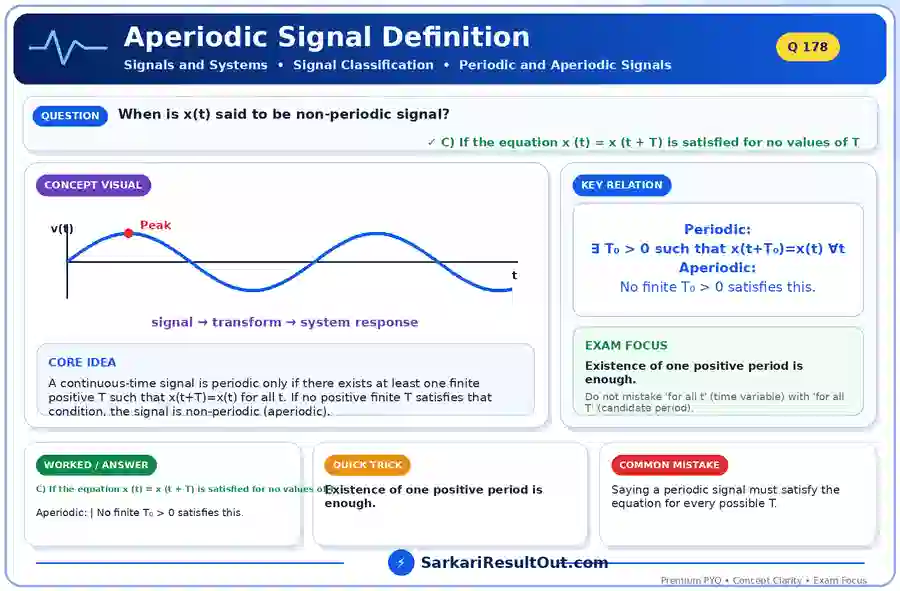
A continuous-time signal is periodic only if there exists at least one finite positive T such that x(t+T)=x(t) for all t. If no positive finite T satisfies that condition, the signal is non-periodic (aperiodic).
Concept & Reasoning
The period condition must hold for every time t, but only one positive fundamental period needs to exist; integer multiples of it are also periods. Therefore the phrase 'no values of T' should be interpreted as no non-zero finite positive period.
How to Solve It in the Exam
Existence of one positive period is enough.
Important Exam Point
Do not mistake 'for all t' (time variable) with 'for all T' (candidate period).
Quick Trick
Existence of one positive period is enough.
Common Mistake
Saying a periodic signal must satisfy the equation for every possible T.

x(t) को अनावर्ती (non-periodic) संकेत कब कहा जाता है?
उत्तर और चरणबद्ध हल
C — जब x(t) = x(t + T) किसी भी परिमित धनात्मक T के लिए सभी t पर संतुष्ट न हो, तब संकेत अनावर्ती (aperiodic) होता है।
विस्तृत हल (मूल भाषा में)
Concept & Reasoning
The period condition must hold for every time t, but only one positive fundamental period needs to exist; integer multiples of it are also periods. Therefore the phrase 'no values of T' should be interpreted as no non-zero finite positive period.
How to Solve It in the Exam
Existence of one positive period is enough.
Important Exam Point
Do not mistake 'for all t' (time variable) with 'for all T' (candidate period).
Quick Trick
Existence of one positive period is enough.
Common Mistake
Saying a periodic signal must satisfy the equation for every possible T.
x(t)ને અનાવર્તી (non-periodic) સંકેત ક્યારે કહેવાય છે?
જવાબ અને પગલાવાર ઉકેલ
C — જ્યારે x(t) = x(t + T) કોઈ પણ મર્યાદિત ધન T માટે તમામ t પર ન સંતોષાય, ત્યારે સંકેત અનાવર્તી (aperiodic) છે.
વિગતવાર ઉકેલ (મૂળ ભાષામાં)
Concept & Reasoning
The period condition must hold for every time t, but only one positive fundamental period needs to exist; integer multiples of it are also periods. Therefore the phrase 'no values of T' should be interpreted as no non-zero finite positive period.
How to Solve It in the Exam
Existence of one positive period is enough.
Important Exam Point
Do not mistake 'for all t' (time variable) with 'for all T' (candidate period).
Quick Trick
Existence of one positive period is enough.
Common Mistake
Saying a periodic signal must satisfy the equation for every possible T.
 More Signals & Classification questions