

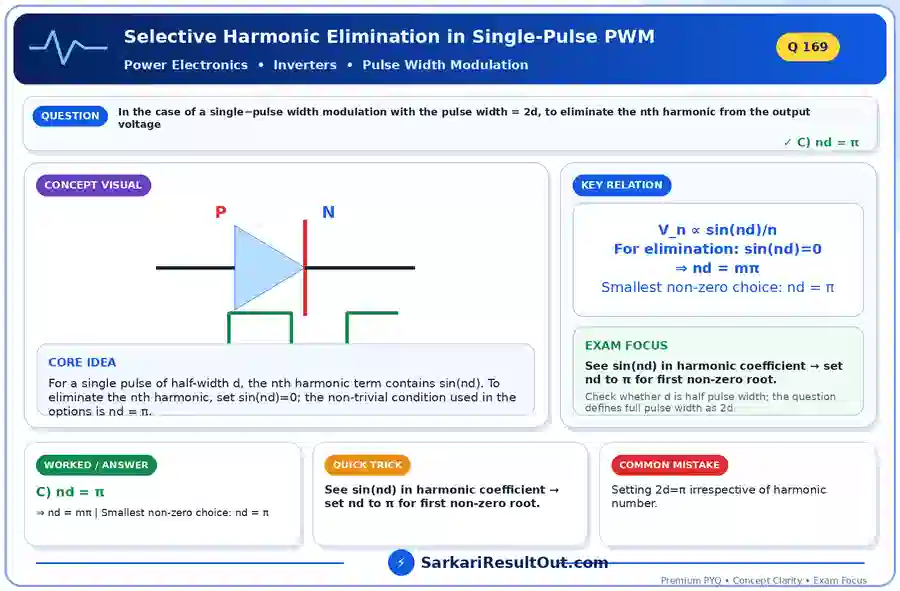
In the case of a single−pulse width modulation with the pulse width = 2d, to eliminate the nth harmonic from the output voltage
 Answer & step-by-step solution

For a single pulse of half-width d, the nth harmonic term contains sin(nd). To eliminate the nth harmonic, set sin(nd)=0; the non-trivial condition used in the options is nd = π.
Concept & Reasoning
Fourier analysis of the single-pulse waveform shows that the amplitude of an nth harmonic is proportional to sin(nd)/n (with additional symmetry restrictions on even/odd harmonics). Therefore harmonic elimination is achieved by choosing a pulse width such that the sine factor vanishes.
How to Solve It in the Exam
See sin(nd) in harmonic coefficient → set nd to π for first non-zero root.
Important Exam Point
Check whether d is half pulse width; the question defines full pulse width as 2d.
Quick Trick
See sin(nd) in harmonic coefficient → set nd to π for first non-zero root.
Common Mistake
Setting 2d=π irrespective of harmonic number.

पल्स चौड़ाई = 2d वाले सिंगल-पल्स विड्थ मॉड्यूलेशन में, आउटपुट वोल्टेज से nवाँ हार्मोनिक हटाने के लिए
उत्तर और चरणबद्ध हल
C — nd = π। अर्ध-चौड़ाई d वाली एकल पल्स के nवें हार्मोनिक पद में sin(nd) होता है। इसे हटाने के लिए sin(nd) = 0 चाहिए; विकल्पों में अतुच्छ शर्त nd = π है।
विस्तृत हल (मूल भाषा में)
Concept & Reasoning
Fourier analysis of the single-pulse waveform shows that the amplitude of an nth harmonic is proportional to sin(nd)/n (with additional symmetry restrictions on even/odd harmonics). Therefore harmonic elimination is achieved by choosing a pulse width such that the sine factor vanishes.
How to Solve It in the Exam
See sin(nd) in harmonic coefficient → set nd to π for first non-zero root.
Important Exam Point
Check whether d is half pulse width; the question defines full pulse width as 2d.
Quick Trick
See sin(nd) in harmonic coefficient → set nd to π for first non-zero root.
Common Mistake
Setting 2d=π irrespective of harmonic number.
પલ્સ પહોળાઈ = 2d વાળા સિંગલ-પલ્સ વિડ્થ મોડ્યુલેશનમાં, આઉટપુટ વોલ્ટેજમાંથી nમો હાર્મોનિક દૂર કરવા
જવાબ અને પગલાવાર ઉકેલ
C — nd = π. અર્ધ-પહોળાઈ d વાળી એક પલ્સના nમા હાર્મોનિક પદમાં sin(nd) હોય છે. તેને દૂર કરવા sin(nd) = 0 જોઈએ; વિકલ્પોમાં બિન-તુચ્છ શરત nd = π છે.
વિગતવાર ઉકેલ (મૂળ ભાષામાં)
Concept & Reasoning
Fourier analysis of the single-pulse waveform shows that the amplitude of an nth harmonic is proportional to sin(nd)/n (with additional symmetry restrictions on even/odd harmonics). Therefore harmonic elimination is achieved by choosing a pulse width such that the sine factor vanishes.
How to Solve It in the Exam
See sin(nd) in harmonic coefficient → set nd to π for first non-zero root.
Important Exam Point
Check whether d is half pulse width; the question defines full pulse width as 2d.
Quick Trick
See sin(nd) in harmonic coefficient → set nd to π for first non-zero root.
Common Mistake
Setting 2d=π irrespective of harmonic number.
 More Inverters questions