

Which of these error-detecting codes enables to find double errors in Digital Electronic devices?
 Answer & step-by-step solution

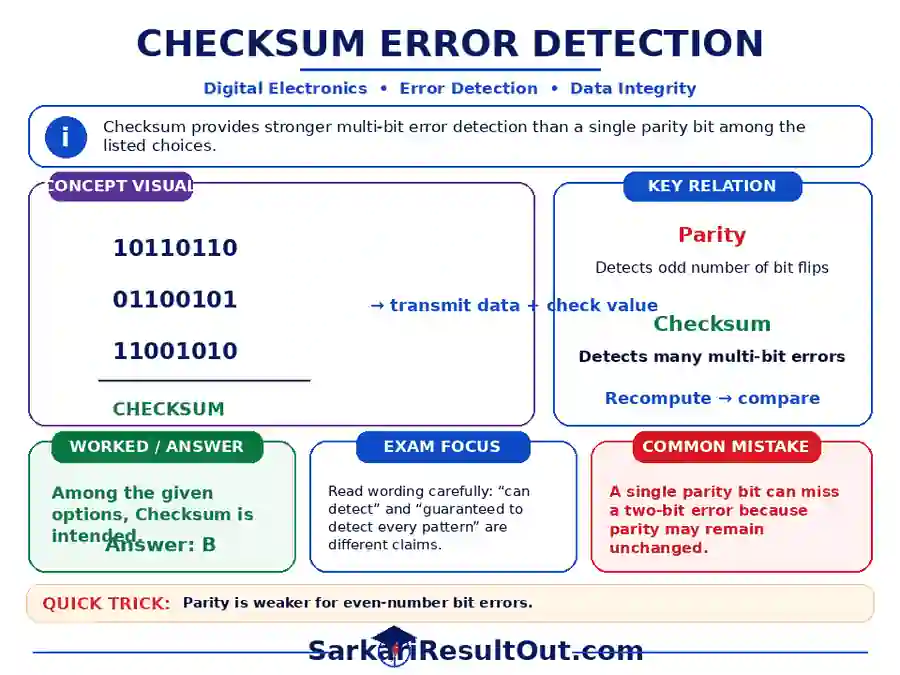
Among the listed choices, checksum coding is the method intended to provide stronger error detection, including many multi-bit error patterns. A simple parity bit reliably detects an odd number of bit errors but can miss two-bit errors because parity may remain unchanged.
Concept & Reasoning
Error-detecting schemes differ in capability. Single parity adds only one redundant bit; flipping two bits can preserve the original parity, so double-error detection is not guaranteed. A checksum combines blocks of data and compares a computed check value at the receiver, giving broader error-detection capability than simple parity in the context of the given options.
How to Solve It in the Exam
If the question contrasts parity with checksum for multiple errors, parity is the weaker choice.
Important Exam Point
Distinguish 'can detect some double errors' from 'guarantees detection of every double error'; the wording of coding questions matters.
Quick Trick
If the question contrasts parity with checksum for multiple errors, parity is the weaker choice.
Common Mistake
Assuming a parity bit detects every two-bit error.

डिजिटल इलेक्ट्रॉनिक उपकरणों में इनमें से कौन-सा त्रुटि-पहचान कोड दोहरी त्रुटियाँ (double errors) पहचानने में सक्षम बनाता है?
उत्तर और चरणबद्ध हल
दिए गए विकल्पों में चेकसम कोडिंग अधिक मज़बूत त्रुटि पहचान देती है, जिसमें कई बहु-बिट त्रुटि पैटर्न शामिल हैं। साधारण पैरिटी बिट विषम संख्या की बिट त्रुटियाँ पहचानता है पर दो-बिट त्रुटि छोड़ सकता है क्योंकि पैरिटी अपरिवर्तित रहती है।
विस्तृत हल (मूल भाषा में)
Concept & Reasoning
Error-detecting schemes differ in capability. Single parity adds only one redundant bit; flipping two bits can preserve the original parity, so double-error detection is not guaranteed. A checksum combines blocks of data and compares a computed check value at the receiver, giving broader error-detection capability than simple parity in the context of the given options.
How to Solve It in the Exam
If the question contrasts parity with checksum for multiple errors, parity is the weaker choice.
Important Exam Point
Distinguish 'can detect some double errors' from 'guarantees detection of every double error'; the wording of coding questions matters.
Quick Trick
If the question contrasts parity with checksum for multiple errors, parity is the weaker choice.
Common Mistake
Assuming a parity bit detects every two-bit error.
ડિજિટલ ઇલેક્ટ્રોનિક ઉપકરણોમાં નીચેનામાંથી કયો ત્રુટિ-ઓળખ કોડ બેવડી ત્રુટિઓ (double errors) ઓળખવામાં સક્ષમ બનાવે છે?
જવાબ અને પગલાવાર ઉકેલ
આપેલ વિકલ્પોમાં ચેકસમ કોડિંગ વધુ મજબૂત ત્રુટિ ઓળખ આપે છે, જેમાં ઘણી બહુ-બિટ ત્રુટિઓ સમાવિષ્ટ છે. સાદો પેરિટી બિટ એકી સંખ્યાની બિટ ત્રુટિઓ ઓળખે છે પરંતુ બે-બિટ ત્રુટિ ચૂકી શકે છે કારણ કે પેરિટી બદલાતી નથી.
વિગતવાર ઉકેલ (મૂળ ભાષામાં)
Concept & Reasoning
Error-detecting schemes differ in capability. Single parity adds only one redundant bit; flipping two bits can preserve the original parity, so double-error detection is not guaranteed. A checksum combines blocks of data and compares a computed check value at the receiver, giving broader error-detection capability than simple parity in the context of the given options.
How to Solve It in the Exam
If the question contrasts parity with checksum for multiple errors, parity is the weaker choice.
Important Exam Point
Distinguish 'can detect some double errors' from 'guarantees detection of every double error'; the wording of coding questions matters.
Quick Trick
If the question contrasts parity with checksum for multiple errors, parity is the weaker choice.
Common Mistake
Assuming a parity bit detects every two-bit error.
 More Number Systems & Codes questions