

A coil has resistance R and inductance L. At ω = ∞, the phase angle between voltage and current is _____________
 Answer & step-by-step solution

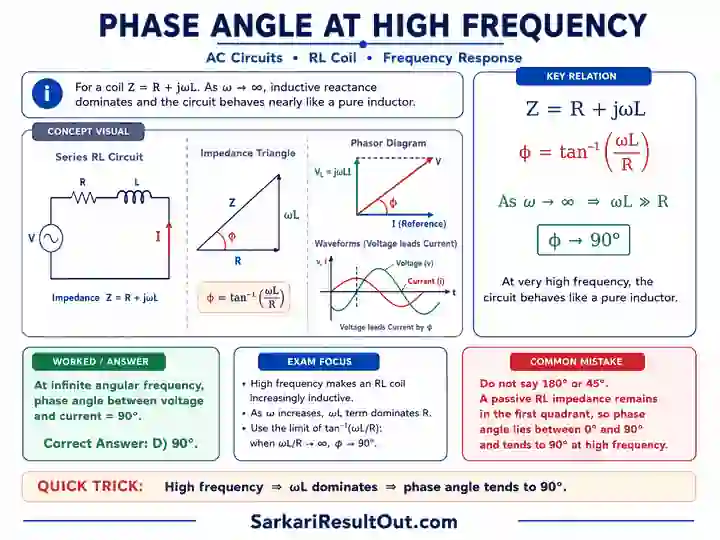
For a coil Z = R + jωL. As ω → ∞, ωL dominates R, so the impedance becomes nearly purely inductive and the voltage leads current by 90°.
Concept & Reasoning
The phase angle of an R-L coil is φ = tan⁻¹(ωL/R). At very low frequency the resistive term can dominate and φ approaches 0°. As frequency increases, inductive reactance grows linearly with ω. In the limit ω → ∞, ωL/R → ∞ and tan⁻¹(∞) = 90°. Thus the coil behaves like an ideal inductor in the high-frequency limit.
How to Solve It in the Exam
High frequency makes an RL coil increasingly inductive.
Important Exam Point
Use the limiting form of tan⁻¹(ωL/R).
Quick Trick
High frequency makes an RL coil increasingly inductive.
Common Mistake
Do not say 180°; passive R-L impedance remains in the first quadrant.

एक कुंडली का प्रतिरोध R और प्रेरकत्व L है। ω = ∞ पर वोल्टेज और धारा के बीच कलान्तर _____________ है
उत्तर और चरणबद्ध हल
D — 90°। कुंडली के लिए Z = R + jωL। ω → ∞ पर ωL, R से बहुत बड़ा हो जाता है, प्रतिबाधा लगभग शुद्ध प्रेरणिक हो जाती है और वोल्टेज धारा से 90° आगे होता है।
विस्तृत हल (मूल भाषा में)
Concept & Reasoning
The phase angle of an R-L coil is φ = tan⁻¹(ωL/R). At very low frequency the resistive term can dominate and φ approaches 0°. As frequency increases, inductive reactance grows linearly with ω. In the limit ω → ∞, ωL/R → ∞ and tan⁻¹(∞) = 90°. Thus the coil behaves like an ideal inductor in the high-frequency limit.
How to Solve It in the Exam
High frequency makes an RL coil increasingly inductive.
Important Exam Point
Use the limiting form of tan⁻¹(ωL/R).
Quick Trick
High frequency makes an RL coil increasingly inductive.
Common Mistake
Do not say 180°; passive R-L impedance remains in the first quadrant.
એક કોઇલનો અવરોધ R અને પ્રેરકત્વ L છે. ω = ∞ પર વોલ્ટેજ અને પ્રવાહ વચ્ચેનો કળાતફાવત _____________ છે
જવાબ અને પગલાવાર ઉકેલ
D — 90°. કોઇલ માટે Z = R + jωL. ω → ∞ પર ωL, R કરતાં ઘણો મોટો થાય છે, અવબાધ લગભગ શુદ્ધ પ્રેરક બને છે અને વોલ્ટેજ પ્રવાહથી 90° આગળ હોય છે.
વિગતવાર ઉકેલ (મૂળ ભાષામાં)
Concept & Reasoning
The phase angle of an R-L coil is φ = tan⁻¹(ωL/R). At very low frequency the resistive term can dominate and φ approaches 0°. As frequency increases, inductive reactance grows linearly with ω. In the limit ω → ∞, ωL/R → ∞ and tan⁻¹(∞) = 90°. Thus the coil behaves like an ideal inductor in the high-frequency limit.
How to Solve It in the Exam
High frequency makes an RL coil increasingly inductive.
Important Exam Point
Use the limiting form of tan⁻¹(ωL/R).
Quick Trick
High frequency makes an RL coil increasingly inductive.
Common Mistake
Do not say 180°; passive R-L impedance remains in the first quadrant.
 More AC Circuits questions