

आवासीय भवनों में छत के पंखे को बिजली आपूर्ति से जोड़ने के लिए सामान्यतः किस प्रकार का तार उपयोग होता है?
 उत्तर और चरणबद्ध हल

A — फ्लेक्सिबल कॉपर तार। उचित रेटिंग का इंसुलेटेड फ्लेक्सिबल कॉपर चालक पंखे के अंतिम आपूर्ति कनेक्शन के लिए उपयुक्त विकल्प है।
विस्तृत हल (मूल भाषा में)
Why Flexible Copper Wire Is Used for Ceiling Fan Connections
A — Flexible copper wire. An appropriately rated, insulated flexible copper conductor is the suitable choice among the given options for the fan’s final supply connection.
Why flexibility matters
A fan connection must pass through a confined connection space and terminate reliably at the fan. A flexible conductor contains many fine strands, so it bends more easily than a single solid conductor of comparable cross-sectional area. This makes routing and handling at the connection more practical and helps accommodate small movements and vibration.
The supply wire is routed to the stationary connection of the fan motor. It does not need to rotate continuously with the blades. Flexibility is useful for the connection, not because the supply wire spins during normal operation.
Why copper is suitable
Copper has low resistivity, so a correctly sized conductor carries the required current with relatively low resistance and voltage drop. The insulation provides electrical separation; copper by itself is not insulation.
This question identifies the wire type, not a universal wire size. The conductor area, insulation rating and termination arrangement must suit the equipment and installation. Do not infer a specific cross-section or conductor count from the question.
Useful Formula
R = ρl/A; voltage drop along a conductor = IR. Wire type alone does not specify its current rating.
Why the Other Options Are Not the Answer
- B — Twisted pair: normally identifies a paired signal/data cable construction in this comparison, rather than the standard flexible appliance connection sought here.
- C — Aluminium armoured cable: is comparatively rigid and suited to different power-cable applications; it is not the typical flexible final connection to a residential fan.
- D — Coaxial cable: is designed around a centre conductor and shield for signal transmission, not this ordinary fan supply connection.
Remember for the Exam
Distinguish the final flexible appliance connection from fixed wiring elsewhere in the building.
Common mistake: Do not choose a cable merely because it has armour or shielding. Mechanical construction must suit the actual connection.
Quick Trick
Fan’s final connection → flexible, insulated conductor → flexible copper wire.
Common Mistake
Do not choose a cable merely because it has armour or shielding. Mechanical construction must suit the actual connection.
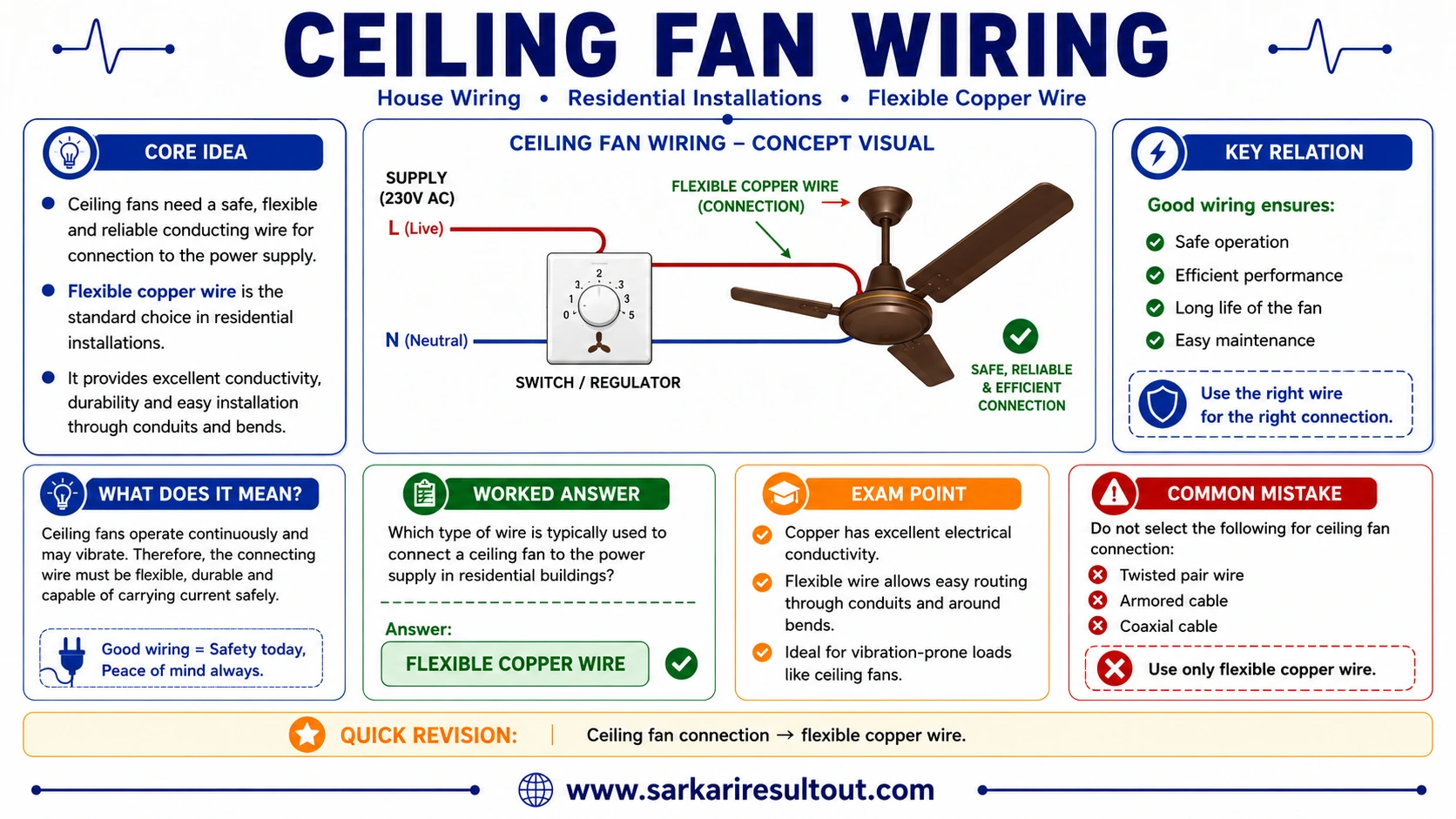
Which type of wire is typically used to connect a ceiling fan to the power supply in residential buildings?
Answer & step-by-step solution
A — Flexible copper wire. An appropriately rated, insulated flexible copper conductor is the suitable choice among the given options for the fan’s final supply connection.
Why Flexible Copper Wire Is Used for Ceiling Fan Connections
A — Flexible copper wire. An appropriately rated, insulated flexible copper conductor is the suitable choice among the given options for the fan’s final supply connection.
Why flexibility matters
A fan connection must pass through a confined connection space and terminate reliably at the fan. A flexible conductor contains many fine strands, so it bends more easily than a single solid conductor of comparable cross-sectional area. This makes routing and handling at the connection more practical and helps accommodate small movements and vibration.
The supply wire is routed to the stationary connection of the fan motor. It does not need to rotate continuously with the blades. Flexibility is useful for the connection, not because the supply wire spins during normal operation.
Why copper is suitable
Copper has low resistivity, so a correctly sized conductor carries the required current with relatively low resistance and voltage drop. The insulation provides electrical separation; copper by itself is not insulation.
This question identifies the wire type, not a universal wire size. The conductor area, insulation rating and termination arrangement must suit the equipment and installation. Do not infer a specific cross-section or conductor count from the question.
Useful Formula
R = ρl/A; voltage drop along a conductor = IR. Wire type alone does not specify its current rating.
Why the Other Options Are Not the Answer
- B — Twisted pair: normally identifies a paired signal/data cable construction in this comparison, rather than the standard flexible appliance connection sought here.
- C — Aluminium armoured cable: is comparatively rigid and suited to different power-cable applications; it is not the typical flexible final connection to a residential fan.
- D — Coaxial cable: is designed around a centre conductor and shield for signal transmission, not this ordinary fan supply connection.
Remember for the Exam
Distinguish the final flexible appliance connection from fixed wiring elsewhere in the building.
Common mistake: Do not choose a cable merely because it has armour or shielding. Mechanical construction must suit the actual connection.
Quick Trick
Fan’s final connection → flexible, insulated conductor → flexible copper wire.
Common Mistake
Do not choose a cable merely because it has armour or shielding. Mechanical construction must suit the actual connection.

રહેણાંક ઇમારતોમાં છતના પંખાને વીજ પુરવઠા સાથે જોડવા સામાન્ય રીતે કયા પ્રકારનો વાયર વપરાય છે?
જવાબ અને પગલાવાર ઉકેલ
A — ફ્લેક્સિબલ કોપર વાયર. યોગ્ય રેટિંગનો ઇન્સ્યુલેટેડ ફ્લેક્સિબલ કોપર વાહક પંખાના અંતિમ પુરવઠા જોડાણ માટે યોગ્ય વિકલ્પ છે.
વિગતવાર ઉકેલ (મૂળ ભાષામાં)
Why Flexible Copper Wire Is Used for Ceiling Fan Connections
A — Flexible copper wire. An appropriately rated, insulated flexible copper conductor is the suitable choice among the given options for the fan’s final supply connection.
Why flexibility matters
A fan connection must pass through a confined connection space and terminate reliably at the fan. A flexible conductor contains many fine strands, so it bends more easily than a single solid conductor of comparable cross-sectional area. This makes routing and handling at the connection more practical and helps accommodate small movements and vibration.
The supply wire is routed to the stationary connection of the fan motor. It does not need to rotate continuously with the blades. Flexibility is useful for the connection, not because the supply wire spins during normal operation.
Why copper is suitable
Copper has low resistivity, so a correctly sized conductor carries the required current with relatively low resistance and voltage drop. The insulation provides electrical separation; copper by itself is not insulation.
This question identifies the wire type, not a universal wire size. The conductor area, insulation rating and termination arrangement must suit the equipment and installation. Do not infer a specific cross-section or conductor count from the question.
Useful Formula
R = ρl/A; voltage drop along a conductor = IR. Wire type alone does not specify its current rating.
Why the Other Options Are Not the Answer
- B — Twisted pair: normally identifies a paired signal/data cable construction in this comparison, rather than the standard flexible appliance connection sought here.
- C — Aluminium armoured cable: is comparatively rigid and suited to different power-cable applications; it is not the typical flexible final connection to a residential fan.
- D — Coaxial cable: is designed around a centre conductor and shield for signal transmission, not this ordinary fan supply connection.
Remember for the Exam
Distinguish the final flexible appliance connection from fixed wiring elsewhere in the building.
Common mistake: Do not choose a cable merely because it has armour or shielding. Mechanical construction must suit the actual connection.
Quick Trick
Fan’s final connection → flexible, insulated conductor → flexible copper wire.
Common Mistake
Do not choose a cable merely because it has armour or shielding. Mechanical construction must suit the actual connection.
 More Wiring & Installation questions