

કોઈ લાઇન દ્વારા અપાતો લેગિંગ પ્રતિક્રિયાશીલ પાવર ______ ના સમપ્રમાણમાં અને ______ થી સ્વતંત્ર હોય છે.
 જવાબ અને પગલાવાર ઉકેલ

C — લાઇન વોલ્ટેજ ડ્રોપ; δ. નાના કોણ અને મુખ્યત્વે પ્રતિઘાતી લાઇનના અંદાજમાં Q ≈ V(V₁ − V₂)/X, એટલે માન-તફાવત (વોલ્ટેજ ડ્રોપ)ના સમપ્રમાણમાં; ચોક્કસ સૂત્રમાં cosδ તો રહે જ છે.
વિગતવાર ઉકેલ (મૂળ ભાષામાં)
Correct answer: C — Line voltage drop; δ
Power flow through a lossless line
Consider a line represented by series reactance X, neglecting resistance and shunt charging. Let V_S and V_R be sending- and receiving-end voltage magnitudes, with angle difference δ. Using per-phase RMS quantities, the receiving-end powers are:
P_R = (V_SV_R/X) sin δ
Q_R = (V_SV_R cos δ − V_R²)/X
Positive Q_R represents lagging reactive power delivered at the receiving end. These equations show that active power depends strongly on angle, while reactive power depends strongly on voltage magnitude.
Step 1: Apply the small-angle approximation. For small δ measured in radians, cos δ ≈ 1. Hence:
Q_R ≈ (V_SV_R − V_R²)/X
Step 2: Factor out the receiving voltage. Define the voltage-magnitude drop as ΔV = V_S − V_R:
Q_R ≈ (V_R/X)(V_S − V_R)
Q_R ≈ (V_R/X)ΔV
At fixed V_R and X, lagging reactive power is approximately proportional to voltage-magnitude drop , and δ does not appear in this approximation. Thus option C is intended. The independence is not exact: at larger angles, the cos δ term matters, and resistance also couples voltage, angle, active power and reactive power.
Quick Trick
Real power follows angle; reactive power follows voltage.
Why Other Options Are Wrong
A reverses the dominant dependencies. B reactance affects the magnitude but reactive power is not independent of power angle in the exact expression simply as stated. D does not represent the standard decoupled relation. C matches the normal small-angle approximation.
Common Mistake
Treating the ‘independent of δ’ statement as exact under all operating conditions; it is an approximation associated with a predominantly reactive line and small δ.
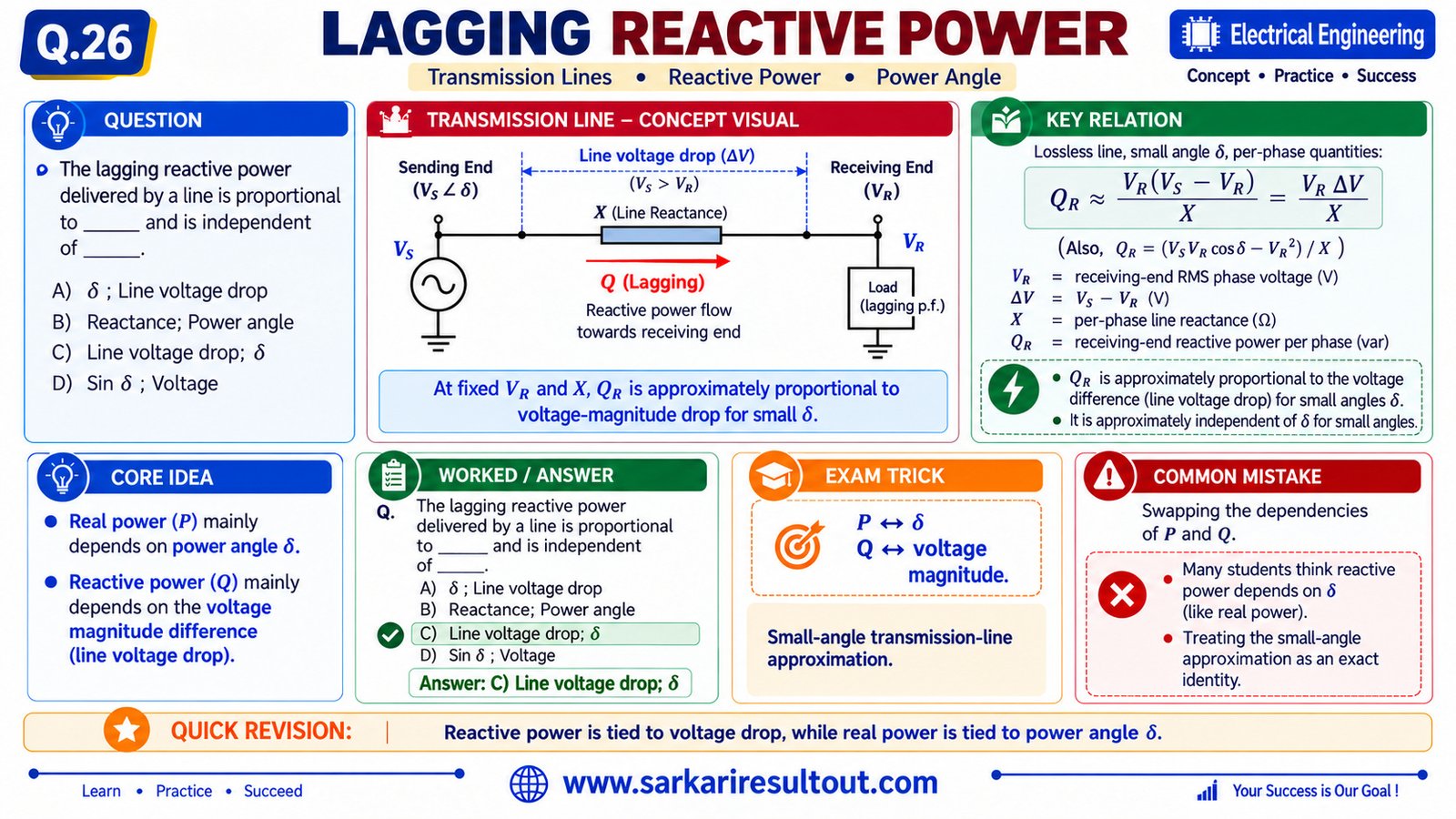
The lagging reactive power delivered by a line is proportional to ______ and is independent of ______.
Answer & step-by-step solution
C — Line voltage drop; δ. This is the small-angle, predominantly reactive-line approximation; the exact reactive-power expression still contains cos δ.
Correct answer: C — Line voltage drop; δ
Power flow through a lossless line
Consider a line represented by series reactance X, neglecting resistance and shunt charging. Let V_S and V_R be sending- and receiving-end voltage magnitudes, with angle difference δ. Using per-phase RMS quantities, the receiving-end powers are:
P_R = (V_SV_R/X) sin δ
Q_R = (V_SV_R cos δ − V_R²)/X
Positive Q_R represents lagging reactive power delivered at the receiving end. These equations show that active power depends strongly on angle, while reactive power depends strongly on voltage magnitude.
Step 1: Apply the small-angle approximation. For small δ measured in radians, cos δ ≈ 1. Hence:
Q_R ≈ (V_SV_R − V_R²)/X
Step 2: Factor out the receiving voltage. Define the voltage-magnitude drop as ΔV = V_S − V_R:
Q_R ≈ (V_R/X)(V_S − V_R)
Q_R ≈ (V_R/X)ΔV
At fixed V_R and X, lagging reactive power is approximately proportional to voltage-magnitude drop , and δ does not appear in this approximation. Thus option C is intended. The independence is not exact: at larger angles, the cos δ term matters, and resistance also couples voltage, angle, active power and reactive power.
Quick Trick
Real power follows angle; reactive power follows voltage.
Why Other Options Are Wrong
A reverses the dominant dependencies. B reactance affects the magnitude but reactive power is not independent of power angle in the exact expression simply as stated. D does not represent the standard decoupled relation. C matches the normal small-angle approximation.
Common Mistake
Treating the ‘independent of δ’ statement as exact under all operating conditions; it is an approximation associated with a predominantly reactive line and small δ.

किसी लाइन द्वारा दी गई लैगिंग प्रतिक्रियाशील शक्ति ______ के समानुपाती और ______ से स्वतंत्र होती है।
उत्तर और चरणबद्ध हल
C — लाइन वोल्टेज ड्रॉप; δ। छोटे कोण और मुख्यतः प्रतिघाती लाइन के सन्निकटन में Q ≈ V(V₁ − V₂)/X, यानी परिमाण-अंतर (वोल्टेज ड्रॉप) के समानुपाती; सटीक व्यंजक में cosδ फिर भी रहता है।
विस्तृत हल (मूल भाषा में)
Correct answer: C — Line voltage drop; δ
Power flow through a lossless line
Consider a line represented by series reactance X, neglecting resistance and shunt charging. Let V_S and V_R be sending- and receiving-end voltage magnitudes, with angle difference δ. Using per-phase RMS quantities, the receiving-end powers are:
P_R = (V_SV_R/X) sin δ
Q_R = (V_SV_R cos δ − V_R²)/X
Positive Q_R represents lagging reactive power delivered at the receiving end. These equations show that active power depends strongly on angle, while reactive power depends strongly on voltage magnitude.
Step 1: Apply the small-angle approximation. For small δ measured in radians, cos δ ≈ 1. Hence:
Q_R ≈ (V_SV_R − V_R²)/X
Step 2: Factor out the receiving voltage. Define the voltage-magnitude drop as ΔV = V_S − V_R:
Q_R ≈ (V_R/X)(V_S − V_R)
Q_R ≈ (V_R/X)ΔV
At fixed V_R and X, lagging reactive power is approximately proportional to voltage-magnitude drop , and δ does not appear in this approximation. Thus option C is intended. The independence is not exact: at larger angles, the cos δ term matters, and resistance also couples voltage, angle, active power and reactive power.
Quick Trick
Real power follows angle; reactive power follows voltage.
Why Other Options Are Wrong
A reverses the dominant dependencies. B reactance affects the magnitude but reactive power is not independent of power angle in the exact expression simply as stated. D does not represent the standard decoupled relation. C matches the normal small-angle approximation.
Common Mistake
Treating the ‘independent of δ’ statement as exact under all operating conditions; it is an approximation associated with a predominantly reactive line and small δ.
 More Transmission Lines questions