

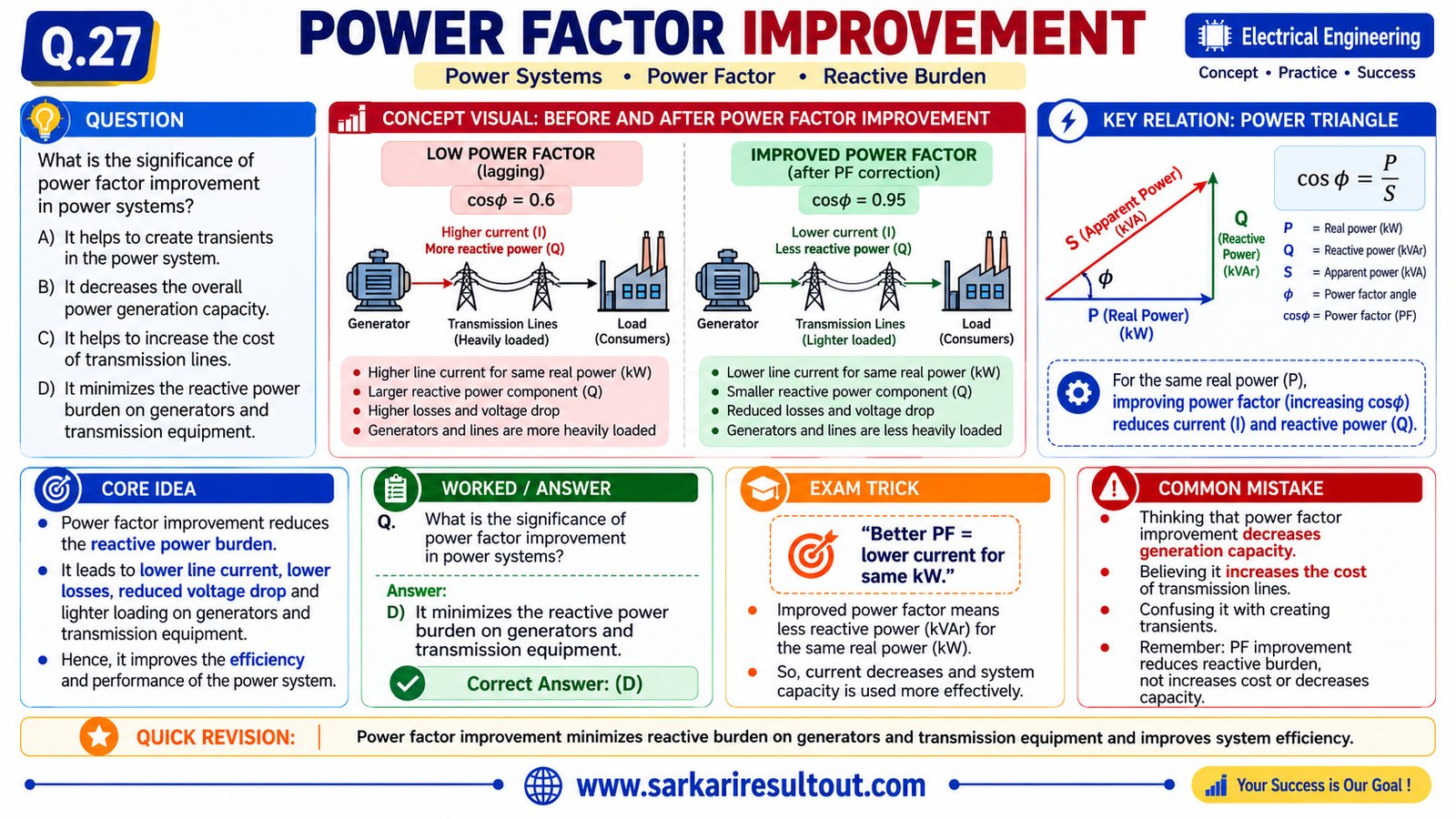
What is the significance of power factor improvement in power systems?
 Answer & step-by-step solution

D — It minimizes the reactive power burden on generators and transmission equipment. Local compensation reduces the reactive current carried upstream.
Correct answer: D — It minimizes the reactive power burden on generators and transmission equipment.
Why low power factor burdens the network
An inductive load draws active power P to perform useful work and reactive power Q to maintain its electromagnetic fields. The supply equipment must carry the resulting apparent power S, even though reactive power does not represent net energy converted into useful work over a full AC cycle.
S = √(P² + Q²)
Power factor = P/S
Power-factor improvement supplies part of the reactive requirement locally, for example through a capacitor bank. This reduces the net reactive power demanded from the upstream network while the useful active-power requirement can remain unchanged.
Effect on current and equipment capacity
I_L = P/(√3 V_Lcos φ)
At fixed active power and voltage, a higher power factor means a smaller line current. The lower current reduces I²R losses, reduces the current-related voltage drop and releases some of the kVA capacity of generators, transformers and lines.
For illustration, a 100 kW load requires 125 kVA at 0.8 power factor but only about 105.3 kVA at 0.95 power factor. Its active-power requirement remains 100 kW; the supply carries less apparent power because the reactive component is smaller. This is the meaning of reducing the reactive-power burden in option D. Compensation should match the load rather than create unnecessary leading VARs.
Quick Trick
PF ↑ → current ↓ → losses and kVA burden ↓.
Why Other Options Are Wrong
A transients are not the purpose. B power-factor improvement increases usable system capacity rather than decreasing it. C it tends to reduce, not increase, transmission cost for a required power transfer. D correctly states the reactive-burden benefit.
Common Mistake
Saying power-factor correction reduces the load’s real kW demand. It mainly reduces reactive demand and line current for the same useful real power.

पावर सिस्टम में पावर फैक्टर सुधार का क्या महत्व है?
उत्तर और चरणबद्ध हल
D — यह जनरेटरों और पारेषण उपकरणों पर प्रतिक्रियाशील शक्ति का बोझ कम करता है। स्थानीय क्षतिपूर्ति ऊपर की ओर (upstream) बहने वाली प्रतिक्रियाशील धारा घटाती है।
विस्तृत हल (मूल भाषा में)
Correct answer: D — It minimizes the reactive power burden on generators and transmission equipment.
Why low power factor burdens the network
An inductive load draws active power P to perform useful work and reactive power Q to maintain its electromagnetic fields. The supply equipment must carry the resulting apparent power S, even though reactive power does not represent net energy converted into useful work over a full AC cycle.
S = √(P² + Q²)
Power factor = P/S
Power-factor improvement supplies part of the reactive requirement locally, for example through a capacitor bank. This reduces the net reactive power demanded from the upstream network while the useful active-power requirement can remain unchanged.
Effect on current and equipment capacity
I_L = P/(√3 V_Lcos φ)
At fixed active power and voltage, a higher power factor means a smaller line current. The lower current reduces I²R losses, reduces the current-related voltage drop and releases some of the kVA capacity of generators, transformers and lines.
For illustration, a 100 kW load requires 125 kVA at 0.8 power factor but only about 105.3 kVA at 0.95 power factor. Its active-power requirement remains 100 kW; the supply carries less apparent power because the reactive component is smaller. This is the meaning of reducing the reactive-power burden in option D. Compensation should match the load rather than create unnecessary leading VARs.
Quick Trick
PF ↑ → current ↓ → losses and kVA burden ↓.
Why Other Options Are Wrong
A transients are not the purpose. B power-factor improvement increases usable system capacity rather than decreasing it. C it tends to reduce, not increase, transmission cost for a required power transfer. D correctly states the reactive-burden benefit.
Common Mistake
Saying power-factor correction reduces the load’s real kW demand. It mainly reduces reactive demand and line current for the same useful real power.
પાવર સિસ્ટમમાં પાવર ફેક્ટર સુધારણાનું શું મહત્વ છે?
જવાબ અને પગલાવાર ઉકેલ
D — તે જનરેટર અને પારેષણ ઉપકરણો પર પ્રતિક્રિયાશીલ પાવરનો બોજ ઘટાડે છે. સ્થાનિક વળતર ઉપર તરફ (upstream) વહેતો પ્રતિક્રિયાશીલ પ્રવાહ ઘટાડે છે.
વિગતવાર ઉકેલ (મૂળ ભાષામાં)
Correct answer: D — It minimizes the reactive power burden on generators and transmission equipment.
Why low power factor burdens the network
An inductive load draws active power P to perform useful work and reactive power Q to maintain its electromagnetic fields. The supply equipment must carry the resulting apparent power S, even though reactive power does not represent net energy converted into useful work over a full AC cycle.
S = √(P² + Q²)
Power factor = P/S
Power-factor improvement supplies part of the reactive requirement locally, for example through a capacitor bank. This reduces the net reactive power demanded from the upstream network while the useful active-power requirement can remain unchanged.
Effect on current and equipment capacity
I_L = P/(√3 V_Lcos φ)
At fixed active power and voltage, a higher power factor means a smaller line current. The lower current reduces I²R losses, reduces the current-related voltage drop and releases some of the kVA capacity of generators, transformers and lines.
For illustration, a 100 kW load requires 125 kVA at 0.8 power factor but only about 105.3 kVA at 0.95 power factor. Its active-power requirement remains 100 kW; the supply carries less apparent power because the reactive component is smaller. This is the meaning of reducing the reactive-power burden in option D. Compensation should match the load rather than create unnecessary leading VARs.
Quick Trick
PF ↑ → current ↓ → losses and kVA burden ↓.
Why Other Options Are Wrong
A transients are not the purpose. B power-factor improvement increases usable system capacity rather than decreasing it. C it tends to reduce, not increase, transmission cost for a required power transfer. D correctly states the reactive-burden benefit.
Common Mistake
Saying power-factor correction reduces the load’s real kW demand. It mainly reduces reactive demand and line current for the same useful real power.
 More Reactive Power Compensation questions