

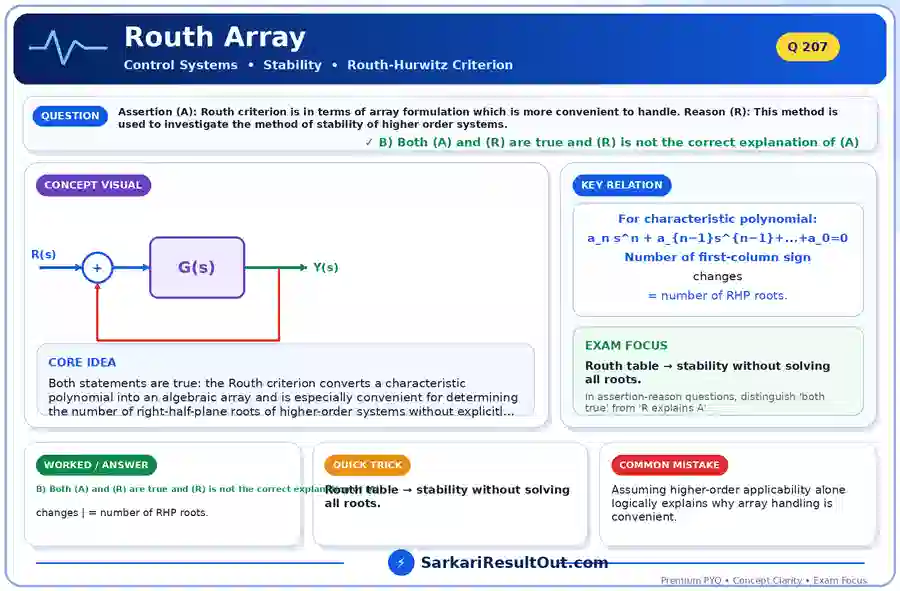
Assertion (A): Routh criterion is in terms of array formulation which is more convenient to handle.
Reason (R): This method is used to investigate the method of stability of higher order systems.
 Answer & step-by-step solution

Both statements are true: the Routh criterion converts a characteristic polynomial into an algebraic array and is especially convenient for determining the number of right-half-plane roots of higher-order systems without explicitly solving for all roots. However, the second statement is a use of the method rather than the precise reason the array formulation is convenient, so the final-key choice is B.
Concept & Reasoning
Routh-Hurwitz stability analysis uses polynomial coefficients to build the Routh table. Changes of sign in the first column equal the number of roots in the right-half s-plane. It scales well to higher-order characteristic equations compared with direct root calculation, while also handling special zero-row/zero-first-element cases with standard procedures.
How to Solve It in the Exam
Routh table → stability without solving all roots.
Important Exam Point
In assertion-reason questions, distinguish 'both true' from 'R explains A'.
Quick Trick
Routh table → stability without solving all roots.
Common Mistake
Assuming higher-order applicability alone logically explains why array handling is convenient.

अभिकथन (A): राउथ मानदंड ऐरे (array) स्वरूप में है जिसे संभालना अधिक सुविधाजनक है।
कारण (R): इस विधि का उपयोग उच्च कोटि के सिस्टम की स्थिरता की जाँच के लिए किया जाता है।
उत्तर और चरणबद्ध हल
दोनों कथन सही हैं: राउथ मानदंड अभिलाक्षणिक बहुपद को बीजगणितीय ऐरे में बदलता है और सभी मूल हल किए बिना दाएँ अर्ध-प्लेन मूलों की संख्या बताता है। परंतु दूसरा कथन विधि का उपयोग है, ऐरे स्वरूप के सुविधाजनक होने का कारण नहीं, अतः अंतिम कुंजी का उत्तर B है।
विस्तृत हल (मूल भाषा में)
Concept & Reasoning
Routh-Hurwitz stability analysis uses polynomial coefficients to build the Routh table. Changes of sign in the first column equal the number of roots in the right-half s-plane. It scales well to higher-order characteristic equations compared with direct root calculation, while also handling special zero-row/zero-first-element cases with standard procedures.
How to Solve It in the Exam
Routh table → stability without solving all roots.
Important Exam Point
In assertion-reason questions, distinguish 'both true' from 'R explains A'.
Quick Trick
Routh table → stability without solving all roots.
Common Mistake
Assuming higher-order applicability alone logically explains why array handling is convenient.
વિધાન (A): રાઉથ માપદંડ એરે (array) સ્વરૂપમાં છે જે સંભાળવામાં વધુ સગવડભર્યું છે.
કારણ (R): આ પદ્ધતિનો ઉપયોગ ઉચ્ચ ક્રમની સિસ્ટમની સ્થિરતા તપાસવા માટે થાય છે.
જવાબ અને પગલાવાર ઉકેલ
બંને વિધાનો સાચાં છે: રાઉથ માપદંડ લાક્ષણિક બહુપદીને બૈજિક એરેમાં ફેરવે છે અને બધાં મૂળ ઉકેલ્યા વગર જમણા અર્ધ-પ્લેનના મૂળની સંખ્યા જણાવે છે. પરંતુ બીજું વિધાન પદ્ધતિનો ઉપયોગ છે, એરે સ્વરૂપ સગવડભર્યું હોવાનું કારણ નથી, તેથી અંતિમ કીનો જવાબ B છે.
વિગતવાર ઉકેલ (મૂળ ભાષામાં)
Concept & Reasoning
Routh-Hurwitz stability analysis uses polynomial coefficients to build the Routh table. Changes of sign in the first column equal the number of roots in the right-half s-plane. It scales well to higher-order characteristic equations compared with direct root calculation, while also handling special zero-row/zero-first-element cases with standard procedures.
How to Solve It in the Exam
Routh table → stability without solving all roots.
Important Exam Point
In assertion-reason questions, distinguish 'both true' from 'R explains A'.
Quick Trick
Routh table → stability without solving all roots.
Common Mistake
Assuming higher-order applicability alone logically explains why array handling is convenient.
 More Stability & Routh-Hurwitz questions