

Which type of generator does not require a separate power source for excitation and operates at variable speeds?
 Answer & step-by-step solution

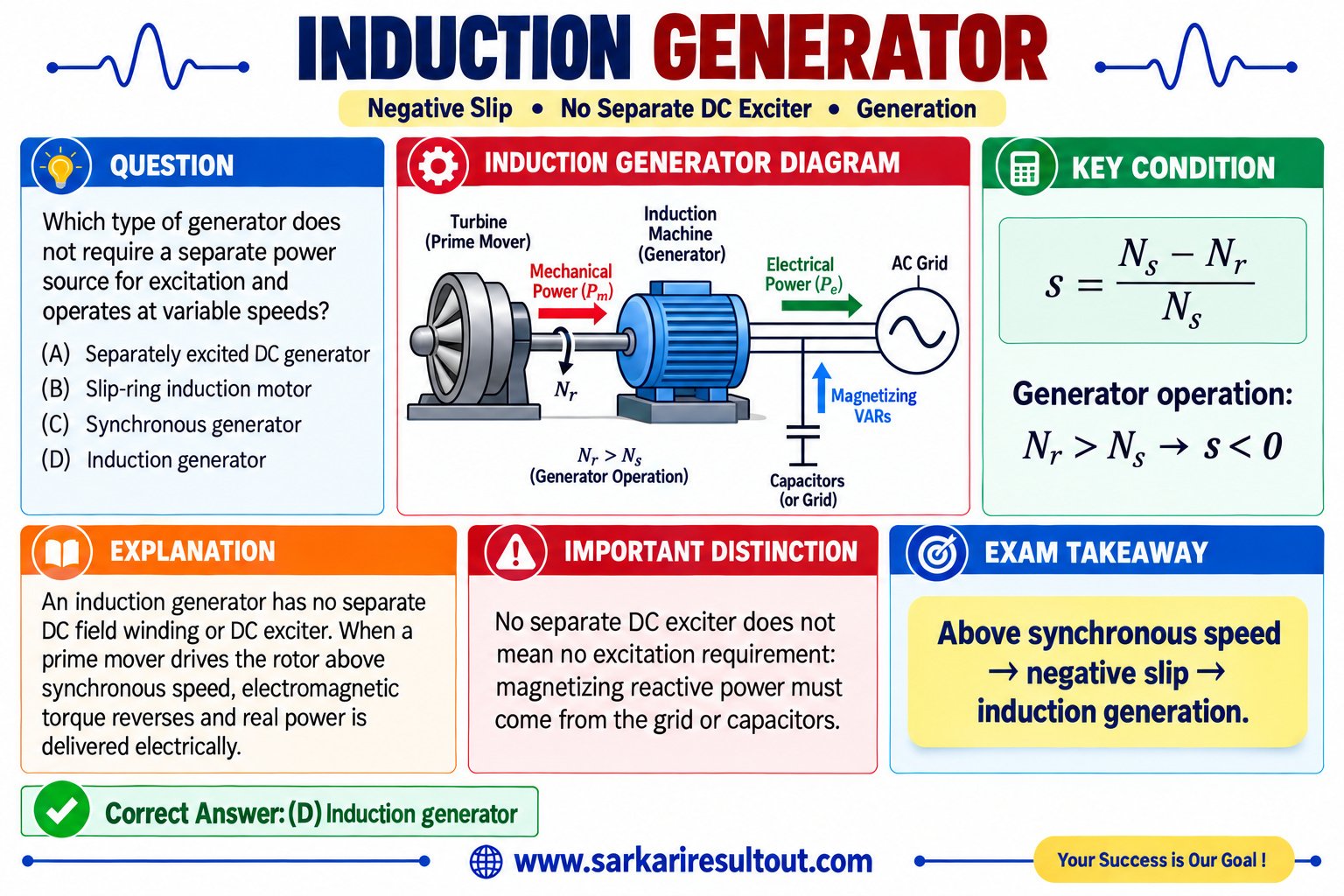
D — Induction generator. It generates when driven above synchronous speed and needs no separate DC rotor-excitation supply, although magnetizing reactive power is still required.
Correct answer: D — Induction generator
How an induction machine generates
An induction generator is an induction machine driven mechanically in its generating region. For a conventional grid-connected machine, generation occurs when the rotor turns faster than the rotating stator field. Its slip becomes negative:
N_s = 120f/P
s = (N_s − N_r)/N_s
N_r > N_s gives s < 0
Here f is supply frequency, P is the number of poles, N_s is synchronous speed and N_r is rotor speed in rpm. In this region, electromagnetic torque opposes the mechanical drive. Mechanical power supplied by the prime mover is converted into electrical power delivered through the stator.
What “no separate excitation source” means
The rotor does not need the separate DC field supply used by a conventional wound-field synchronous generator. However, the air-gap magnetic field still requires magnetizing reactive power . A grid-connected induction generator draws it from the grid or local compensation. A suitable standalone self-excited arrangement obtains it from capacitors, subject to residual magnetism, speed and load conditions.
A directly grid-connected induction generator operates over a limited speed range above synchronous speed while grid frequency remains fixed. A wide variable-speed range generally requires power-electronic conversion. Thus, the answer does not mean that excitation energy is unnecessary or that every induction generator supports unrestricted speed variation.
Quick Trick
Induction machine above synchronous speed → generator.
Why Other Options Are Wrong
A requires separate field excitation. B is identified as a motor, not the requested generator. C normally needs rotor field excitation. D best matches the stated characteristics.
Common Mistake
Saying an induction generator is completely self-excited in every case. Grid-connected units take magnetizing VARs from the grid; isolated units need suitable capacitors and residual magnetism.

किस प्रकार के जनरेटर को उत्तेजन के लिए अलग शक्ति स्रोत की आवश्यकता नहीं होती और यह परिवर्तनशील गति पर चलता है?
उत्तर और चरणबद्ध हल
D — इंडक्शन जनरेटर। सिंक्रोनस गति से ऊपर चलाने पर यह विद्युत उत्पन्न करता है और इसे अलग DC रोटर-उत्तेजन सप्लाई नहीं चाहिए, यद्यपि मैग्नेटाइज़िंग प्रतिक्रियाशील शक्ति फिर भी आवश्यक है।
विस्तृत हल (मूल भाषा में)
Correct answer: D — Induction generator
How an induction machine generates
An induction generator is an induction machine driven mechanically in its generating region. For a conventional grid-connected machine, generation occurs when the rotor turns faster than the rotating stator field. Its slip becomes negative:
N_s = 120f/P
s = (N_s − N_r)/N_s
N_r > N_s gives s < 0
Here f is supply frequency, P is the number of poles, N_s is synchronous speed and N_r is rotor speed in rpm. In this region, electromagnetic torque opposes the mechanical drive. Mechanical power supplied by the prime mover is converted into electrical power delivered through the stator.
What “no separate excitation source” means
The rotor does not need the separate DC field supply used by a conventional wound-field synchronous generator. However, the air-gap magnetic field still requires magnetizing reactive power . A grid-connected induction generator draws it from the grid or local compensation. A suitable standalone self-excited arrangement obtains it from capacitors, subject to residual magnetism, speed and load conditions.
A directly grid-connected induction generator operates over a limited speed range above synchronous speed while grid frequency remains fixed. A wide variable-speed range generally requires power-electronic conversion. Thus, the answer does not mean that excitation energy is unnecessary or that every induction generator supports unrestricted speed variation.
Quick Trick
Induction machine above synchronous speed → generator.
Why Other Options Are Wrong
A requires separate field excitation. B is identified as a motor, not the requested generator. C normally needs rotor field excitation. D best matches the stated characteristics.
Common Mistake
Saying an induction generator is completely self-excited in every case. Grid-connected units take magnetizing VARs from the grid; isolated units need suitable capacitors and residual magnetism.
કયા પ્રકારના જનરેટરને ઉત્તેજન માટે અલગ પાવર સ્રોતની જરૂર નથી અને તે બદલાતી ઝડપે ચાલે છે?
જવાબ અને પગલાવાર ઉકેલ
D — ઇન્ડક્શન જનરેટર. સિંક્રોનસ ઝડપ કરતાં વધુ ઝડપે ચલાવતાં તે વિદ્યુત ઉત્પન્ન કરે છે અને તેને અલગ DC રોટર-ઉત્તેજન સપ્લાયની જરૂર નથી, જોકે મેગ્નેટાઇઝિંગ રિએક્ટિવ પાવર હજુ જરૂરી છે.
વિગતવાર ઉકેલ (મૂળ ભાષામાં)
Correct answer: D — Induction generator
How an induction machine generates
An induction generator is an induction machine driven mechanically in its generating region. For a conventional grid-connected machine, generation occurs when the rotor turns faster than the rotating stator field. Its slip becomes negative:
N_s = 120f/P
s = (N_s − N_r)/N_s
N_r > N_s gives s < 0
Here f is supply frequency, P is the number of poles, N_s is synchronous speed and N_r is rotor speed in rpm. In this region, electromagnetic torque opposes the mechanical drive. Mechanical power supplied by the prime mover is converted into electrical power delivered through the stator.
What “no separate excitation source” means
The rotor does not need the separate DC field supply used by a conventional wound-field synchronous generator. However, the air-gap magnetic field still requires magnetizing reactive power . A grid-connected induction generator draws it from the grid or local compensation. A suitable standalone self-excited arrangement obtains it from capacitors, subject to residual magnetism, speed and load conditions.
A directly grid-connected induction generator operates over a limited speed range above synchronous speed while grid frequency remains fixed. A wide variable-speed range generally requires power-electronic conversion. Thus, the answer does not mean that excitation energy is unnecessary or that every induction generator supports unrestricted speed variation.
Quick Trick
Induction machine above synchronous speed → generator.
Why Other Options Are Wrong
A requires separate field excitation. B is identified as a motor, not the requested generator. C normally needs rotor field excitation. D best matches the stated characteristics.
Common Mistake
Saying an induction generator is completely self-excited in every case. Grid-connected units take magnetizing VARs from the grid; isolated units need suitable capacitors and residual magnetism.
 More Induction Motors questions