

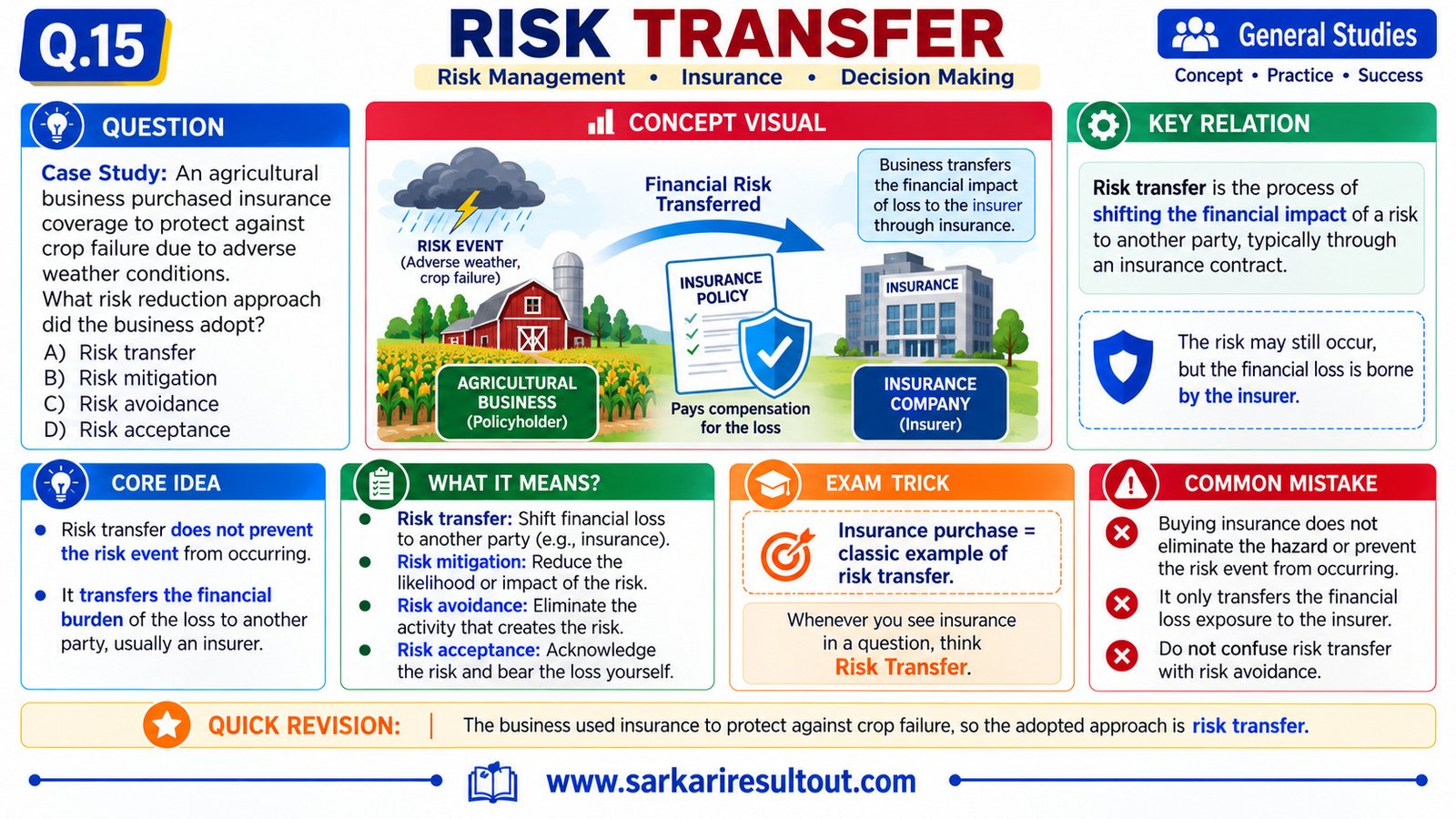
Case Study: An agricultural business purchased insurance coverage to protect against crop failure due to adverse weather conditions. What risk reduction approach did the business adopt?
 Answer & step-by-step solution

A — Risk transfer. Buying crop insurance shifts the covered financial consequences of crop failure to the insurer under the policy terms.
Correct answer: A — Risk transfer
Identifying the risk response in the case study
The agricultural business faces crop failure caused by adverse weather. The action described is the purchase of insurance coverage . Insurance creates a contract under which the business pays a premium and the insurer agrees to meet covered losses, subject to the policy conditions.
To classify this action, identify what has changed. The business still grows crops and remains exposed to adverse weather. Buying the policy does not itself prevent drought, heavy rainfall or crop damage. What changes is who bears the covered financial loss after the insured event occurs. This shift of financial responsibility is risk transfer .
For example, if a covered crop-loss claim is accepted, the insurer pays according to the agreed cover. The business may still retain a deductible, losses above the sum insured, excluded events or other uncovered expenses. Risk transfer can therefore be partial; it does not mean that every consequence of the event has disappeared.
In this question, the decisive evidence is the insurance contract. The premium is the cost of arranging the transfer, while the insurer’s obligation to compensate covered loss is the mechanism that makes it a risk-transfer response.
Quick Trick
Insurance = transfer.
Why Other Options Are Wrong
B mitigation would reduce probability/impact through operational controls. C avoidance would stop the risky activity. D acceptance means retaining the loss exposure without transferring it. A matches insurance.
Common Mistake
Calling insurance mitigation simply because it reduces financial pain. It transfers the covered financial consequence; it does not reduce the weather hazard itself.

केस स्टडी: एक कृषि व्यवसाय ने प्रतिकूल मौसम के कारण फसल विफलता से बचाव के लिए बीमा कवरेज खरीदा। व्यवसाय ने कौन-सा जोखिम न्यूनीकरण दृष्टिकोण अपनाया?
उत्तर और चरणबद्ध हल
A — जोखिम हस्तांतरण। फसल बीमा खरीदने से फसल विफलता के आर्थिक परिणाम पॉलिसी शर्तों के तहत बीमाकर्ता पर स्थानांतरित हो जाते हैं।
विस्तृत हल (मूल भाषा में)
Correct answer: A — Risk transfer
Identifying the risk response in the case study
The agricultural business faces crop failure caused by adverse weather. The action described is the purchase of insurance coverage . Insurance creates a contract under which the business pays a premium and the insurer agrees to meet covered losses, subject to the policy conditions.
To classify this action, identify what has changed. The business still grows crops and remains exposed to adverse weather. Buying the policy does not itself prevent drought, heavy rainfall or crop damage. What changes is who bears the covered financial loss after the insured event occurs. This shift of financial responsibility is risk transfer .
For example, if a covered crop-loss claim is accepted, the insurer pays according to the agreed cover. The business may still retain a deductible, losses above the sum insured, excluded events or other uncovered expenses. Risk transfer can therefore be partial; it does not mean that every consequence of the event has disappeared.
In this question, the decisive evidence is the insurance contract. The premium is the cost of arranging the transfer, while the insurer’s obligation to compensate covered loss is the mechanism that makes it a risk-transfer response.
Quick Trick
Insurance = transfer.
Why Other Options Are Wrong
B mitigation would reduce probability/impact through operational controls. C avoidance would stop the risky activity. D acceptance means retaining the loss exposure without transferring it. A matches insurance.
Common Mistake
Calling insurance mitigation simply because it reduces financial pain. It transfers the covered financial consequence; it does not reduce the weather hazard itself.
કેસ સ્ટડી: એક કૃષિ વ્યવસાયે પ્રતિકૂળ હવામાનને કારણે પાક નિષ્ફળતા સામે રક્ષણ માટે વીમા કવરેજ ખરીદ્યું. વ્યવસાયે કયો જોખમ ઘટાડવાનો અભિગમ અપનાવ્યો?
જવાબ અને પગલાવાર ઉકેલ
A — જોખમ હસ્તાંતરણ. પાક વીમો ખરીદવાથી પાક નિષ્ફળતાનાં આર્થિક પરિણામો પોલિસી શરતો હેઠળ વીમા કંપની પર ખસેડાય છે.
વિગતવાર ઉકેલ (મૂળ ભાષામાં)
Correct answer: A — Risk transfer
Identifying the risk response in the case study
The agricultural business faces crop failure caused by adverse weather. The action described is the purchase of insurance coverage . Insurance creates a contract under which the business pays a premium and the insurer agrees to meet covered losses, subject to the policy conditions.
To classify this action, identify what has changed. The business still grows crops and remains exposed to adverse weather. Buying the policy does not itself prevent drought, heavy rainfall or crop damage. What changes is who bears the covered financial loss after the insured event occurs. This shift of financial responsibility is risk transfer .
For example, if a covered crop-loss claim is accepted, the insurer pays according to the agreed cover. The business may still retain a deductible, losses above the sum insured, excluded events or other uncovered expenses. Risk transfer can therefore be partial; it does not mean that every consequence of the event has disappeared.
In this question, the decisive evidence is the insurance contract. The premium is the cost of arranging the transfer, while the insurer’s obligation to compensate covered loss is the mechanism that makes it a risk-transfer response.
Quick Trick
Insurance = transfer.
Why Other Options Are Wrong
B mitigation would reduce probability/impact through operational controls. C avoidance would stop the risky activity. D acceptance means retaining the loss exposure without transferring it. A matches insurance.
Common Mistake
Calling insurance mitigation simply because it reduces financial pain. It transfers the covered financial consequence; it does not reduce the weather hazard itself.
 More Risk & Quality Management questions