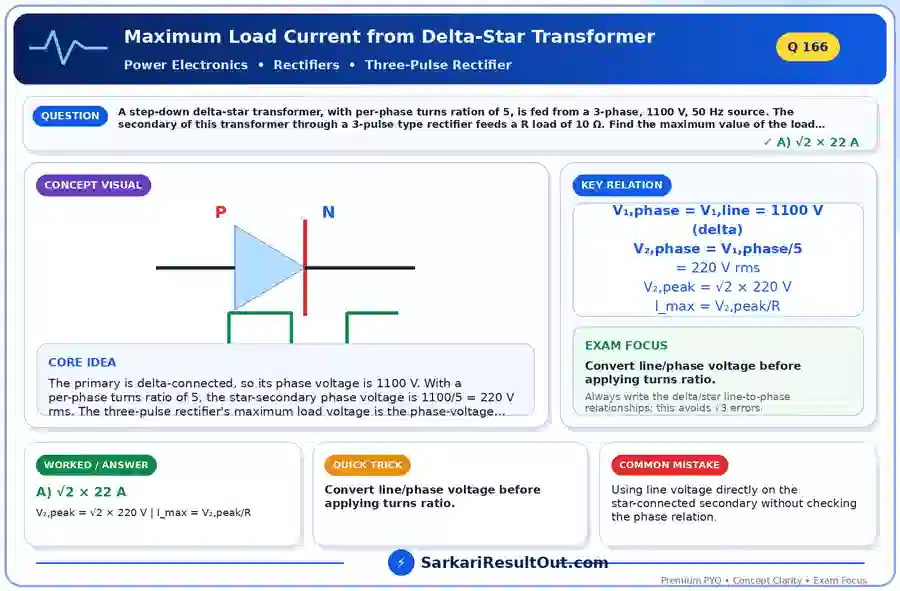
A step-down delta-star transformer, with per-phase turns ration of 5, is fed from a 3-phase, 1100 V, 50 Hz source. The secondary of this transformer through a 3-pulse type rectifier feeds a R load of 10 Ω. Find the maximum value of the load current (phase).
⚑ Report issue
Found a wrong answer, translation, image or source problem? Send it to editorial review.
The primary is delta-connected, so its phase voltage is 1100 V. With a per-phase turns ratio of 5, the star-secondary phase voltage is 1100/5 = 220 V rms. The three-pulse rectifier's maximum load voltage is the phase-voltage peak, so I_max = √2×220/10 = √2×22 A.
Formula / Key Relation
V₁,phase = V₁,line = 1100 V (delta)
V₂,phase = V₁,phase/5
= 220 V rms
V₂,peak = √2 × 220 V
Imax = V₂,peak/R
= (√2×220)/10
= √2 × 22 A
Detailed Explanation
Concept & ReasoningBecause the primary is delta, V1,phase = V1,line = 1100 V. The per-phase turns ratio N1/N2=5 gives V2,phase=220 V rms. A three-pulse midpoint rectifier connected to the star secondary uses the phase-to-neutral secondary voltages, whose peak is √2V2,phase. For a 10 Ω resistive load, the maximum instantaneous load current is therefore √2×22 A. This calculation is a good example of why line/phase voltage must be resolved before applying transformer ratio and rectifier relations.How to Solve It in the ExamConvert line/phase voltage before applying turns ratio.Important Exam PointAlways write the delta/star line-to-phase relationships; this avoids √3 errors.Related Revision PathThis…
Concept & Reasoning
Because the primary is delta, V1,phase = V1,line = 1100 V. The per-phase turns ratio N1/N2=5 gives V2,phase=220 V rms. A three-pulse midpoint rectifier connected to the star secondary uses the phase-to-neutral secondary voltages, whose peak is √2V2,phase. For a 10 Ω resistive load, the maximum instantaneous load current is therefore √2×22 A. This calculation is a good example of why line/phase voltage must be resolved before applying transformer ratio and rectifier relations.
How to Solve It in the Exam
Convert line/phase voltage before applying turns ratio.
Important Exam Point
Always write the delta/star line-to-phase relationships; this avoids √3 errors.
Related Revision Path
This question sits in the revision path Power Electronics → Rectifiers → Three-Pulse Rectifier .
Quick Trick
Convert line/phase voltage before applying turns ratio.
Common Mistake
Using line voltage directly on the star-connected secondary without checking the phase relation.
Exam Tip
Always write the delta/star line-to-phase relationships; this avoids √3 errors.
SEO + Knowledge GraphRelated PYQs & Exam ContextExam path, knowledge path and deeper practice links.
Assistant Engineer (Electrical), Class-2, Road and Building Department2025Q. 166Assistant Engineer (Electrical), Class-2, Road and Building Department2025Q. 166Assistant Engineer (Electrical), Class-2, Road and Building Department2025Q. 166Assistant Engineer (Electrical), Class-2, Road and Building Department2025Q. 166Assistant Engineer (Electrical), Class-2, Road and Building Department2025Q. 166Assistant Engineer (Electrical), Class-2, Road and Building Department2025Q. 166Assistant Engineer (Electrical), Class-2, Road and Building Department2025Q. 166Assistant Engineer (Electrical), Class-2, Road and Building Department2025Q. 166Assistant Engineer (Electrical), Class-2, Road and Building Department2025Q. 166Assistant Engineer (Electrical), Class-2, Road and Building Department2025Q. 166