

ग्रीष्म संक्रांति (summer solstice) के दौरान सूर्य का झुकाव कोण (declination angle) क्या होता है?
 उत्तर और चरणबद्ध हल

A — +23.5°। उत्तरी गोलार्ध की ग्रीष्म संक्रांति पर सूर्य का झुकाव लगभग +23.45° (प्रायः +23.5°) होता है, जब सूर्य कर्क रेखा के निकट सिर के ठीक ऊपर होता है।
विस्तृत हल (मूल भाषा में)
Concept & Reasoning
Solar declination δ is the angular position of the Sun north or south of the celestial equator. Over a year it varies approximately between +23.45° and −23.45° due to Earth's axial tilt. Around 21 June it is at its positive maximum.
How to Solve It in the Exam
June solstice +23.5°, December solstice −23.5°.
Important Exam Point
Check hemisphere/sign convention if a problem specifies location/date differently.
Quick Trick
June solstice +23.5°, December solstice −23.5°.
Common Mistake
Using 0°—that is the equinox value.
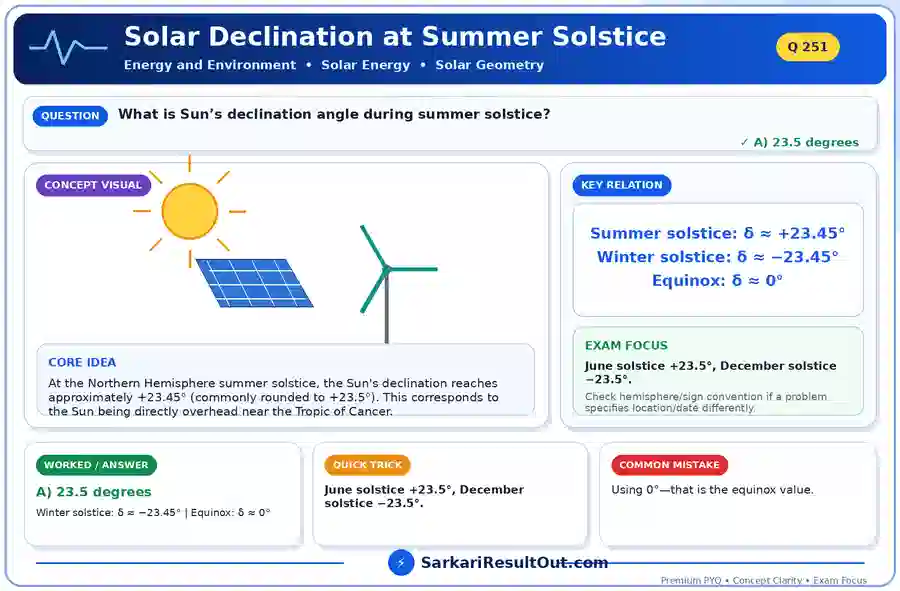
What is Sun’s declination angle during summer solstice?
Answer & step-by-step solution
At the Northern Hemisphere summer solstice, the Sun's declination reaches approximately +23.45° (commonly rounded to +23.5°). This corresponds to the Sun being directly overhead near the Tropic of Cancer.
Concept & Reasoning
Solar declination δ is the angular position of the Sun north or south of the celestial equator. Over a year it varies approximately between +23.45° and −23.45° due to Earth's axial tilt. Around 21 June it is at its positive maximum.
How to Solve It in the Exam
June solstice +23.5°, December solstice −23.5°.
Important Exam Point
Check hemisphere/sign convention if a problem specifies location/date differently.
Quick Trick
June solstice +23.5°, December solstice −23.5°.
Common Mistake
Using 0°—that is the equinox value.

ઉનાળુ અયનકાળ (summer solstice) દરમિયાન સૂર્યનો ક્રાંતિ કોણ (declination angle) શું હોય છે?
જવાબ અને પગલાવાર ઉકેલ
A — +23.5°. ઉત્તર ગોળાર્ધના ઉનાળુ અયનકાળે સૂર્યનો ક્રાંતિ કોણ આશરે +23.45° (સામાન્ય રીતે +23.5°) હોય છે, જ્યારે સૂર્ય કર્કવૃત્ત નજીક બરાબર માથા ઉપર હોય છે.
વિગતવાર ઉકેલ (મૂળ ભાષામાં)
Concept & Reasoning
Solar declination δ is the angular position of the Sun north or south of the celestial equator. Over a year it varies approximately between +23.45° and −23.45° due to Earth's axial tilt. Around 21 June it is at its positive maximum.
How to Solve It in the Exam
June solstice +23.5°, December solstice −23.5°.
Important Exam Point
Check hemisphere/sign convention if a problem specifies location/date differently.
Quick Trick
June solstice +23.5°, December solstice −23.5°.
Common Mistake
Using 0°—that is the equinox value.
 More Renewable Energy Sources questions