

मिट्टी की प्रतिरोधकता पर लवण (salt) की उपस्थिति का क्या प्रभाव होता है?
 उत्तर और चरणबद्ध हल

B — लवण की मात्रा बढ़ने पर प्रतिरोधकता घटती है। घुले लवण नम मिट्टी में गतिशील आयन जोड़ते हैं और उसकी विद्युत चालकता बढ़ाते हैं।
विस्तृत हल (मूल भाषा में)
Correct answer: B — Resistivity decreases with increase in salt content
Ionic conduction in soil
Electrical conduction through moist soil occurs largely through the water in the spaces between soil particles. Dissolved salts separate into positive and negative ions. Under an electric field, these ions move and carry current, increasing the conductivity of the pore water.
With adequate moisture and otherwise comparable conditions, increasing the concentration of dissolved salts generally increases soil conductivity σ. Resistivity ρ is its reciprocal:
ρ = 1/σ
A rise in conductivity therefore means a fall in resistivity. For example, if conductivity changes from 0.01 S/m to 0.02 S/m, the corresponding resistivity changes from 100 Ω·m to 50 Ω·m. This illustrates the inverse relation; it does not imply that doubling the salt content always doubles conductivity.
For the same electrode geometry, lower soil resistivity generally lowers earth-electrode resistance and improves current dissipation into the surrounding ground. The effect depends on the salt actually dissolving, so moisture and temperature also matter. Adding dry salt to very dry soil does not guarantee the same response.
The question asks for the physical trend, which is decreasing resistivity with increasing dissolved salt content . Practical soil-treatment decisions also consider corrosion and the long-term stability of the treatment.
Quick Trick
Salt adds ions → resistance/resistivity falls.
Why Other Options Are Wrong
A is physically opposite to ionic conduction. C predicts the wrong trend. D ignores the strong dependence of soil resistivity on moisture and dissolved salts. B is correct.
Common Mistake
Confusing soil resistivity with corrosion rate; salts can lower resistivity while simultaneously increasing corrosion risk.
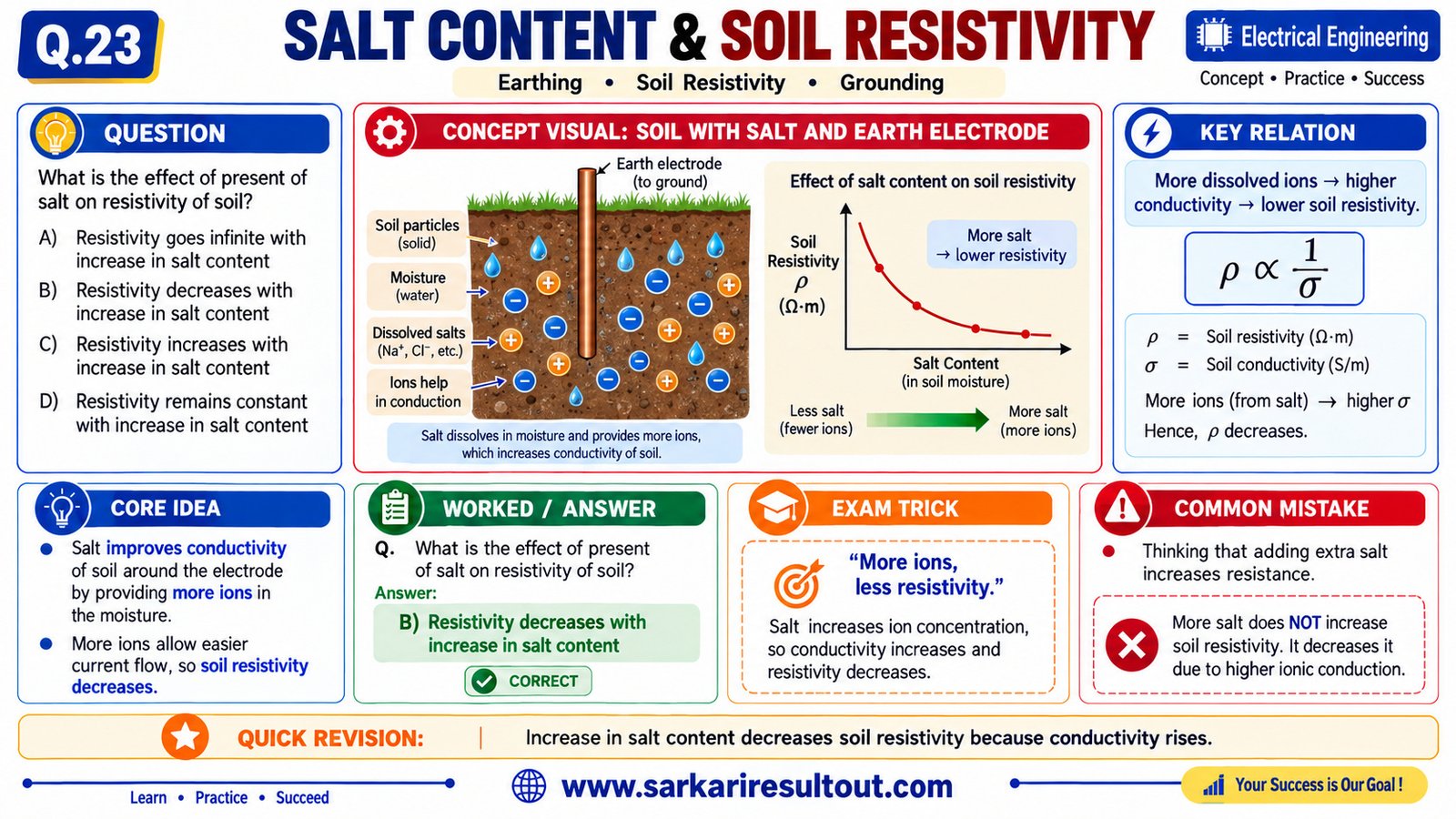
What is the effect of present of salt on resistivity of soil?
Answer & step-by-step solution
B — Resistivity decreases with increase in salt content. Dissolved salts add mobile ions to moist soil and increase its electrical conductivity.
Correct answer: B — Resistivity decreases with increase in salt content
Ionic conduction in soil
Electrical conduction through moist soil occurs largely through the water in the spaces between soil particles. Dissolved salts separate into positive and negative ions. Under an electric field, these ions move and carry current, increasing the conductivity of the pore water.
With adequate moisture and otherwise comparable conditions, increasing the concentration of dissolved salts generally increases soil conductivity σ. Resistivity ρ is its reciprocal:
ρ = 1/σ
A rise in conductivity therefore means a fall in resistivity. For example, if conductivity changes from 0.01 S/m to 0.02 S/m, the corresponding resistivity changes from 100 Ω·m to 50 Ω·m. This illustrates the inverse relation; it does not imply that doubling the salt content always doubles conductivity.
For the same electrode geometry, lower soil resistivity generally lowers earth-electrode resistance and improves current dissipation into the surrounding ground. The effect depends on the salt actually dissolving, so moisture and temperature also matter. Adding dry salt to very dry soil does not guarantee the same response.
The question asks for the physical trend, which is decreasing resistivity with increasing dissolved salt content . Practical soil-treatment decisions also consider corrosion and the long-term stability of the treatment.
Quick Trick
Salt adds ions → resistance/resistivity falls.
Why Other Options Are Wrong
A is physically opposite to ionic conduction. C predicts the wrong trend. D ignores the strong dependence of soil resistivity on moisture and dissolved salts. B is correct.
Common Mistake
Confusing soil resistivity with corrosion rate; salts can lower resistivity while simultaneously increasing corrosion risk.

જમીનની અવરોધકતા પર ક્ષાર (salt)ની હાજરીની શું અસર થાય છે?
જવાબ અને પગલાવાર ઉકેલ
B — ક્ષારનું પ્રમાણ વધતાં અવરોધકતા ઘટે છે. ઓગળેલા ક્ષારો ભીની જમીનમાં ગતિશીલ આયનો ઉમેરે છે અને તેની વિદ્યુત વાહકતા વધારે છે.
વિગતવાર ઉકેલ (મૂળ ભાષામાં)
Correct answer: B — Resistivity decreases with increase in salt content
Ionic conduction in soil
Electrical conduction through moist soil occurs largely through the water in the spaces between soil particles. Dissolved salts separate into positive and negative ions. Under an electric field, these ions move and carry current, increasing the conductivity of the pore water.
With adequate moisture and otherwise comparable conditions, increasing the concentration of dissolved salts generally increases soil conductivity σ. Resistivity ρ is its reciprocal:
ρ = 1/σ
A rise in conductivity therefore means a fall in resistivity. For example, if conductivity changes from 0.01 S/m to 0.02 S/m, the corresponding resistivity changes from 100 Ω·m to 50 Ω·m. This illustrates the inverse relation; it does not imply that doubling the salt content always doubles conductivity.
For the same electrode geometry, lower soil resistivity generally lowers earth-electrode resistance and improves current dissipation into the surrounding ground. The effect depends on the salt actually dissolving, so moisture and temperature also matter. Adding dry salt to very dry soil does not guarantee the same response.
The question asks for the physical trend, which is decreasing resistivity with increasing dissolved salt content . Practical soil-treatment decisions also consider corrosion and the long-term stability of the treatment.
Quick Trick
Salt adds ions → resistance/resistivity falls.
Why Other Options Are Wrong
A is physically opposite to ionic conduction. C predicts the wrong trend. D ignores the strong dependence of soil resistivity on moisture and dissolved salts. B is correct.
Common Mistake
Confusing soil resistivity with corrosion rate; salts can lower resistivity while simultaneously increasing corrosion risk.
 More Earthing questions