

SVC और STATCOM की तुलना में निम्नलिखित में से कौन-सा कथन सही है?
 उत्तर और चरणबद्ध हल

B — STATCOM रिएक्टेंस के पीछे वोल्टेज स्रोत की तरह और SVC परिवर्ती सस्पेक्टेंस की तरह कार्य करता है। इसलिए कम वोल्टेज पर भी STATCOM पूरी प्रतिक्रियाशील धारा दे सकता है और प्रायः तेज़ है।
विस्तृत हल (मूल भाषा में)
Correct answer: B — STATCOM acts as a voltage source behind a reactance and SVC acts as a variable susceptance.
SVC: variable shunt susceptance
A Static Var Compensator (SVC) regulates reactive power using shunt capacitor and reactor branches controlled or switched by thyristors. Its fundamental-frequency equivalent is a controllable susceptance B connected to the bus. With capacitive injection defined as positive:
Q_SVC = V²B
At the limit of available capacitive susceptance, its maximum capacitive VAR output falls approximately with the square of bus voltage. This is an important limitation during a deep voltage reduction.
STATCOM: controllable voltage behind reactance
A STATCOM uses a voltage-source converter connected to the network through coupling reactance. If its converter voltage E is approximately in phase with bus voltage V, the voltage-magnitude difference drives reactive current:
I = (E − V)/(jX)
If E is greater than V, the STATCOM supplies capacitive reactive power to the bus. If E is smaller than V, it absorbs reactive power. The coupling reactance X limits and controls this current exchange.
A STATCOM can maintain approximately its rated reactive current over part of its low-voltage operating range, subject to converter limits. Its reactive power still decreases with voltage because Q is proportional to VI. The decisive distinction in this question is the equivalent model: variable susceptance for SVC; voltage source behind reactance for STATCOM .
Quick Trick
SVC → B (susceptance); STATCOM → V-source.
Why Other Options Are Wrong
A reverses the usual dynamic-performance comparison. C is incorrect because STATCOM is not the slower device. D is also opposite to the usual comparison; converter switching does create harmonics, but modern STATCOMs are not characterized simply as having ‘higher harmonics’ than SVCs as a defining advantage/disadvantage.
Common Mistake
Assuming both devices are just variable capacitors. Their circuit models and low-voltage VAR characteristics are fundamentally different.
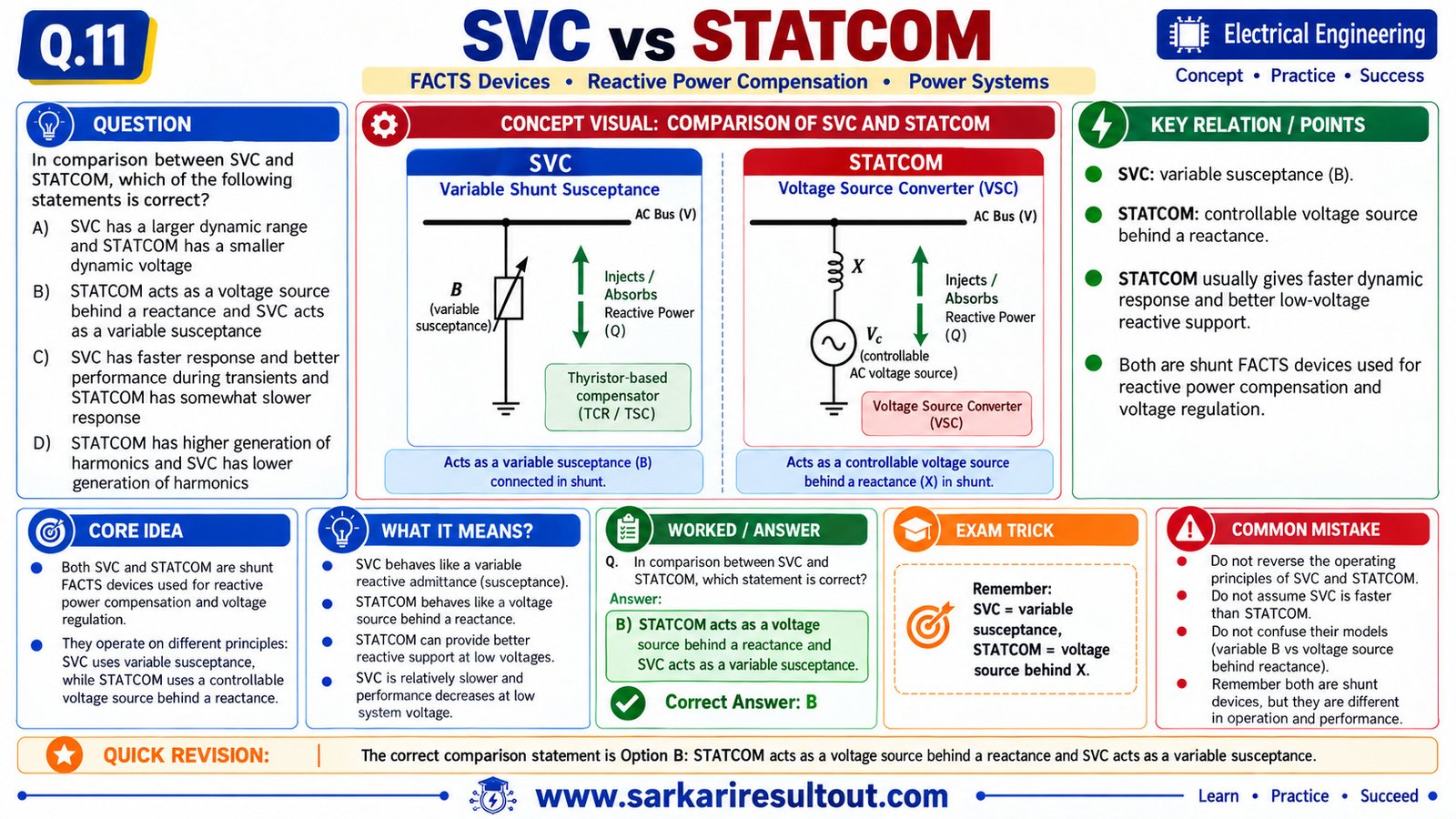
In Comparison between SVC and STATCOM which of the following statements is correct?
Answer & step-by-step solution
B — A STATCOM acts as a voltage source behind a reactance, while an SVC acts as a variable susceptance.
Correct answer: B — STATCOM acts as a voltage source behind a reactance and SVC acts as a variable susceptance.
SVC: variable shunt susceptance
A Static Var Compensator (SVC) regulates reactive power using shunt capacitor and reactor branches controlled or switched by thyristors. Its fundamental-frequency equivalent is a controllable susceptance B connected to the bus. With capacitive injection defined as positive:
Q_SVC = V²B
At the limit of available capacitive susceptance, its maximum capacitive VAR output falls approximately with the square of bus voltage. This is an important limitation during a deep voltage reduction.
STATCOM: controllable voltage behind reactance
A STATCOM uses a voltage-source converter connected to the network through coupling reactance. If its converter voltage E is approximately in phase with bus voltage V, the voltage-magnitude difference drives reactive current:
I = (E − V)/(jX)
If E is greater than V, the STATCOM supplies capacitive reactive power to the bus. If E is smaller than V, it absorbs reactive power. The coupling reactance X limits and controls this current exchange.
A STATCOM can maintain approximately its rated reactive current over part of its low-voltage operating range, subject to converter limits. Its reactive power still decreases with voltage because Q is proportional to VI. The decisive distinction in this question is the equivalent model: variable susceptance for SVC; voltage source behind reactance for STATCOM .
Quick Trick
SVC → B (susceptance); STATCOM → V-source.
Why Other Options Are Wrong
A reverses the usual dynamic-performance comparison. C is incorrect because STATCOM is not the slower device. D is also opposite to the usual comparison; converter switching does create harmonics, but modern STATCOMs are not characterized simply as having ‘higher harmonics’ than SVCs as a defining advantage/disadvantage.
Common Mistake
Assuming both devices are just variable capacitors. Their circuit models and low-voltage VAR characteristics are fundamentally different.

SVC અને STATCOMની તુલનામાં નીચેનામાંથી કયું વિધાન સાચું છે?
જવાબ અને પગલાવાર ઉકેલ
B — STATCOM રિએક્ટન્સ પાછળ વોલ્ટેજ સ્રોત જેવું અને SVC પરિવર્તી સસેપ્ટન્સ જેવું કાર્ય કરે છે. તેથી નીચા વોલ્ટેજે પણ STATCOM સંપૂર્ણ પ્રતિક્રિયાશીલ પ્રવાહ આપી શકે છે અને સામાન્ય રીતે ઝડપી છે.
વિગતવાર ઉકેલ (મૂળ ભાષામાં)
Correct answer: B — STATCOM acts as a voltage source behind a reactance and SVC acts as a variable susceptance.
SVC: variable shunt susceptance
A Static Var Compensator (SVC) regulates reactive power using shunt capacitor and reactor branches controlled or switched by thyristors. Its fundamental-frequency equivalent is a controllable susceptance B connected to the bus. With capacitive injection defined as positive:
Q_SVC = V²B
At the limit of available capacitive susceptance, its maximum capacitive VAR output falls approximately with the square of bus voltage. This is an important limitation during a deep voltage reduction.
STATCOM: controllable voltage behind reactance
A STATCOM uses a voltage-source converter connected to the network through coupling reactance. If its converter voltage E is approximately in phase with bus voltage V, the voltage-magnitude difference drives reactive current:
I = (E − V)/(jX)
If E is greater than V, the STATCOM supplies capacitive reactive power to the bus. If E is smaller than V, it absorbs reactive power. The coupling reactance X limits and controls this current exchange.
A STATCOM can maintain approximately its rated reactive current over part of its low-voltage operating range, subject to converter limits. Its reactive power still decreases with voltage because Q is proportional to VI. The decisive distinction in this question is the equivalent model: variable susceptance for SVC; voltage source behind reactance for STATCOM .
Quick Trick
SVC → B (susceptance); STATCOM → V-source.
Why Other Options Are Wrong
A reverses the usual dynamic-performance comparison. C is incorrect because STATCOM is not the slower device. D is also opposite to the usual comparison; converter switching does create harmonics, but modern STATCOMs are not characterized simply as having ‘higher harmonics’ than SVCs as a defining advantage/disadvantage.
Common Mistake
Assuming both devices are just variable capacitors. Their circuit models and low-voltage VAR characteristics are fundamentally different.
 More FACTS questions