Previous Year Question
Correct answer: C
Explanation
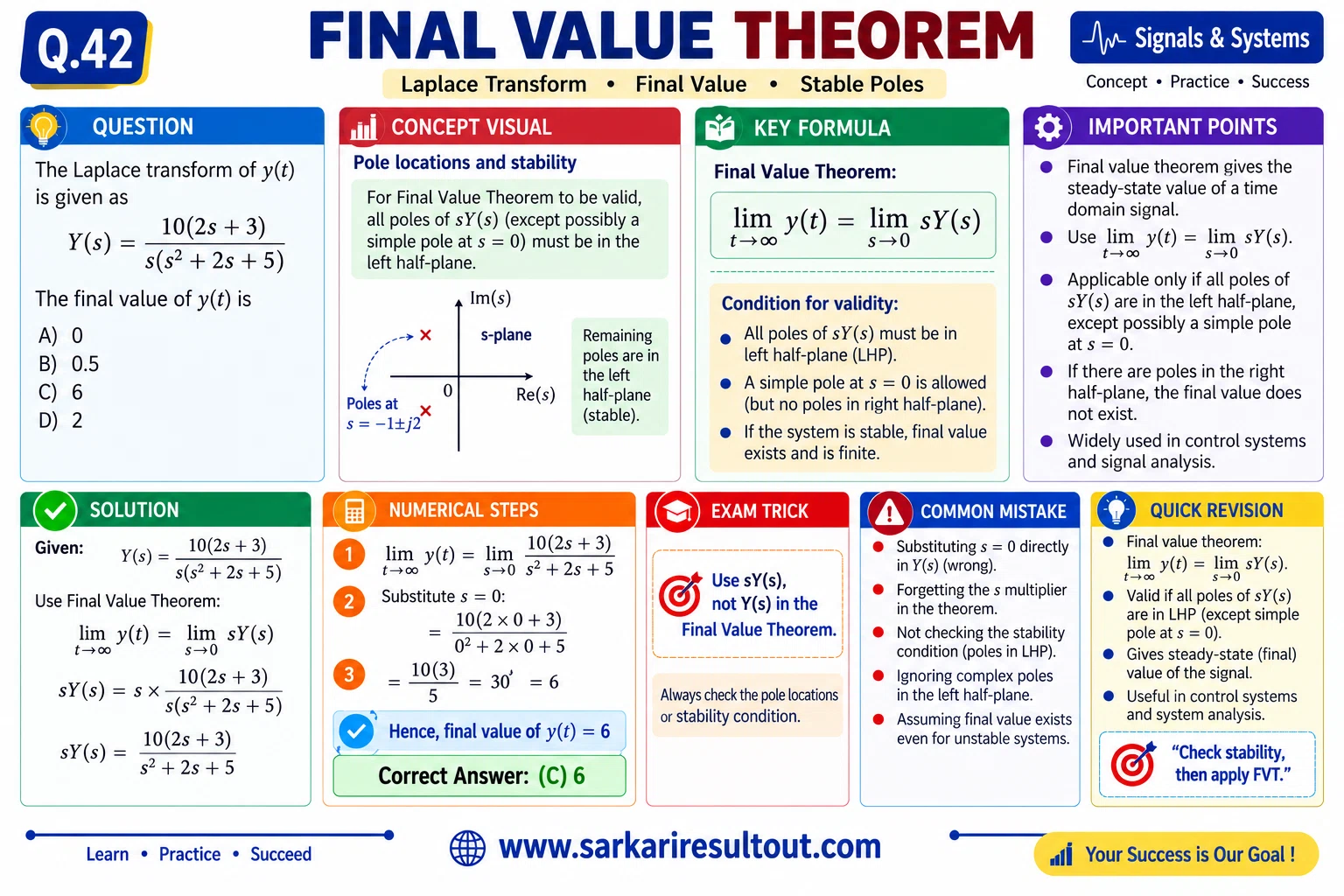
Apply the final-value theorem: y(∞)=lim_{s→0}sY(s). With Y(s)=10(2s+3)/[s(s²+2s+5)], the limit is 10×3/5=6. The poles of sY(s) are in the left half-plane, so the theorem is applicable. Hence option C.
Formula
Step-by-step solution
Correct Answer
C — 6
Concept and Reasoning
Apply the final-value theorem: y(∞)=lim_{s→0}sY(s). With Y(s)=10(2s+3)/[s(s²+2s+5)], the limit is 10×3/5=6. The poles of sY(s) are in the left half-plane, so the theorem is applicable. Hence option C.
Calculation / Key Relation
y(∞)=lim sY(s)=lim 10(2s+3)/(s²+2s+5)=6
Exam Takeaway
Cancel the integrator through sY(s), then check stability of the remaining poles.
Common Mistake
Do not substitute s=0 directly into Y(s); the final-value theorem uses sY(s).
Common mistake
Do not substitute s=0 directly into Y(s); the final-value theorem uses sY(s).
Exam tip
Cancel the integrator through sY(s), then check stability of the remaining poles.
Quick method
Cancel the integrator through sY(s), then check stability of the remaining poles.