

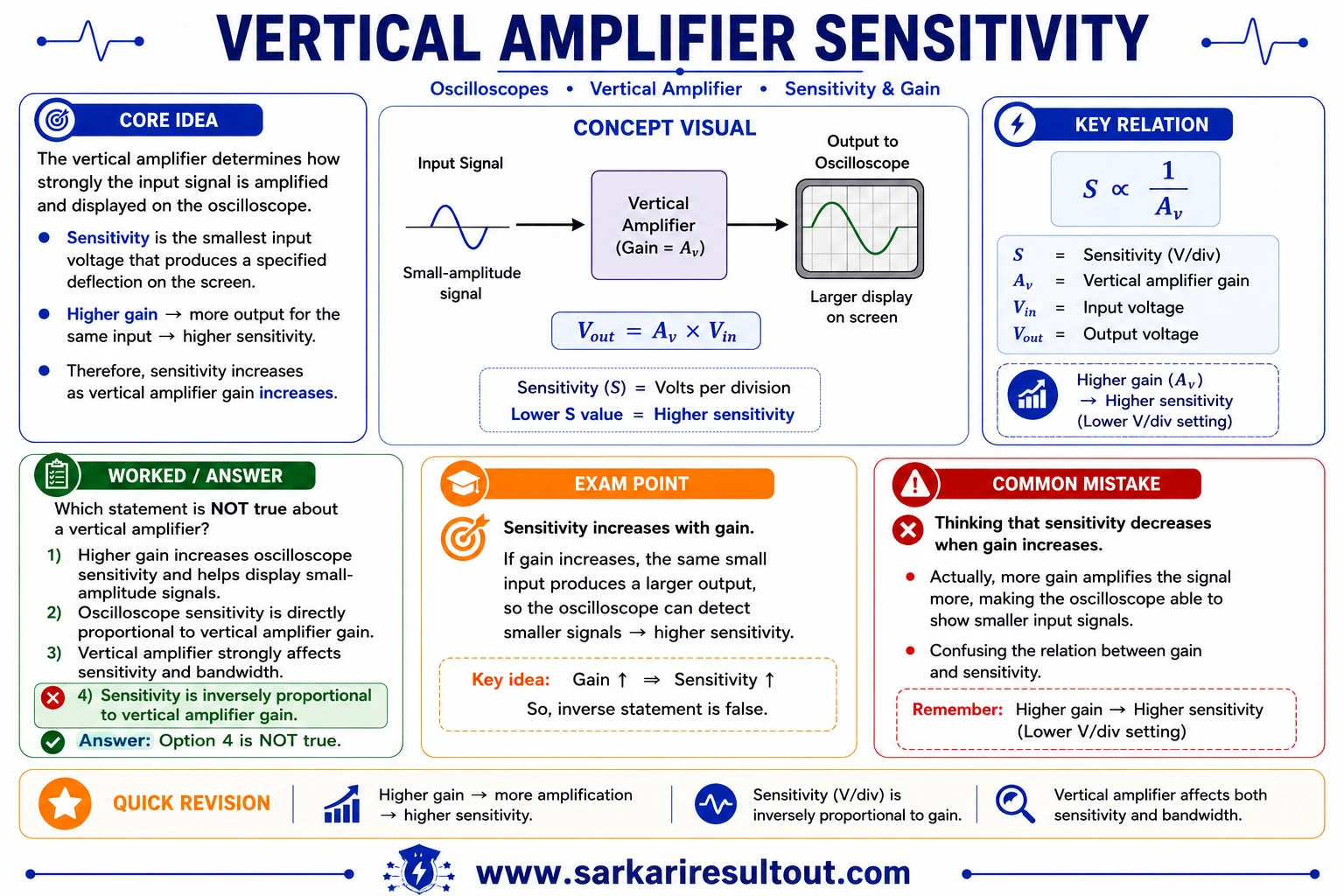
Which of the following statements is not true about a vertical amplifier?
 Answer & step-by-step solution

D — “Sensitivity is inversely proportional to the gain” is the incorrect statement under the question’s deflection-per-volt definition of sensitivity. Increasing vertical gain increases screen deflection for the same input voltage.
Vertical Amplifier Gain and Oscilloscope Sensitivity
D — “Sensitivity is inversely proportional to the gain” is the incorrect statement under the question’s deflection-per-volt definition of sensitivity. Increasing vertical gain increases screen deflection for the same input voltage.
How vertical gain affects the display
The vertical amplifier increases the input signal before it drives the vertical display system. With the remaining settings fixed, a larger voltage gain produces greater vertical deflection for the same input. Smaller signals therefore become easier to observe.
Let A_v be amplifier voltage gain and k be the display’s deflection per volt at the amplifier output. For an input V_in, deflection y = kA_vV_in. Input-referred deflection sensitivity is S = y/V_in = kA_v, so S is directly proportional to A_v.
The important distinction: div/V versus V/div
Sensitivity expressed as divisions per volt increases with gain. The front-panel scale expressed as volts per division is its reciprocal, so its numerical value decreases as the display becomes more sensitive.
For example, a 0.2 V signal occupies 1 division at 0.2 V/div but 2 divisions at 0.1 V/div. The smaller V/div setting gives the more sensitive display. This reciprocal relationship explains why option D can look tempting.
What the bandwidth statement means
The vertical signal path is a major factor in the oscilloscope’s sensitivity and bandwidth. This does not mean that merely increasing gain always increases bandwidth; practical amplifier bandwidth is limited by its frequency response.
Useful Formula
y = kA_vV_in; S = y/V_in = kA_v; vertical scale in V/div = 1/S when S is in div/V.
Why the Other Options Are Not the Answer
- A — True: greater gain allows a small-amplitude signal to produce more visible deflection.
- B — True: deflection-per-volt sensitivity is directly proportional to vertical gain when other factors are fixed.
- C — True in the conventional oscilloscope context: the vertical amplifier strongly influences sensitivity and bandwidth.
Remember for the Exam
The question asks which statement is NOT true. Select the false statement, not one of the three correct properties.
Common mistake: Do not confuse increased sensitivity with an increased numerical V/div setting. They move in opposite directions.
Reference: Tektronix: Oscilloscope Systems and Controls — vertical scale
Quick Trick
Gain ↑ → deflection per volt ↑ → numerical V/div setting ↓.
Common Mistake
Do not confuse increased sensitivity with an increased numerical V/div setting. They move in opposite directions.

वर्टिकल एम्पलीफायर के बारे में निम्नलिखित में से कौन-सा कथन सत्य नहीं है?
उत्तर और चरणबद्ध हल
D — “संवेदनशीलता गेन के व्युत्क्रमानुपाती है” कथन गलत है। समान इनपुट वोल्टेज पर वर्टिकल गेन बढ़ाने से स्क्रीन विक्षेपण बढ़ता है, यानी संवेदनशीलता बढ़ती है।
विस्तृत हल (मूल भाषा में)
Vertical Amplifier Gain and Oscilloscope Sensitivity
D — “Sensitivity is inversely proportional to the gain” is the incorrect statement under the question’s deflection-per-volt definition of sensitivity. Increasing vertical gain increases screen deflection for the same input voltage.
How vertical gain affects the display
The vertical amplifier increases the input signal before it drives the vertical display system. With the remaining settings fixed, a larger voltage gain produces greater vertical deflection for the same input. Smaller signals therefore become easier to observe.
Let A_v be amplifier voltage gain and k be the display’s deflection per volt at the amplifier output. For an input V_in, deflection y = kA_vV_in. Input-referred deflection sensitivity is S = y/V_in = kA_v, so S is directly proportional to A_v.
The important distinction: div/V versus V/div
Sensitivity expressed as divisions per volt increases with gain. The front-panel scale expressed as volts per division is its reciprocal, so its numerical value decreases as the display becomes more sensitive.
For example, a 0.2 V signal occupies 1 division at 0.2 V/div but 2 divisions at 0.1 V/div. The smaller V/div setting gives the more sensitive display. This reciprocal relationship explains why option D can look tempting.
What the bandwidth statement means
The vertical signal path is a major factor in the oscilloscope’s sensitivity and bandwidth. This does not mean that merely increasing gain always increases bandwidth; practical amplifier bandwidth is limited by its frequency response.
Useful Formula
y = kA_vV_in; S = y/V_in = kA_v; vertical scale in V/div = 1/S when S is in div/V.
Why the Other Options Are Not the Answer
- A — True: greater gain allows a small-amplitude signal to produce more visible deflection.
- B — True: deflection-per-volt sensitivity is directly proportional to vertical gain when other factors are fixed.
- C — True in the conventional oscilloscope context: the vertical amplifier strongly influences sensitivity and bandwidth.
Remember for the Exam
The question asks which statement is NOT true. Select the false statement, not one of the three correct properties.
Common mistake: Do not confuse increased sensitivity with an increased numerical V/div setting. They move in opposite directions.
Reference: Tektronix: Oscilloscope Systems and Controls — vertical scale
Quick Trick
Gain ↑ → deflection per volt ↑ → numerical V/div setting ↓.
Common Mistake
Do not confuse increased sensitivity with an increased numerical V/div setting. They move in opposite directions.
વર્ટિકલ એમ્પ્લિફાયર વિશે નીચેનામાંથી કયું વિધાન સાચું નથી?
જવાબ અને પગલાવાર ઉકેલ
D — “સંવેદનશીલતા ગેઇનના વ્યસ્ત પ્રમાણમાં છે” વિધાન ખોટું છે. સમાન ઇનપુટ વોલ્ટેજે વર્ટિકલ ગેઇન વધારવાથી સ્ક્રીન વિચલન વધે છે, એટલે સંવેદનશીલતા વધે છે.
વિગતવાર ઉકેલ (મૂળ ભાષામાં)
Vertical Amplifier Gain and Oscilloscope Sensitivity
D — “Sensitivity is inversely proportional to the gain” is the incorrect statement under the question’s deflection-per-volt definition of sensitivity. Increasing vertical gain increases screen deflection for the same input voltage.
How vertical gain affects the display
The vertical amplifier increases the input signal before it drives the vertical display system. With the remaining settings fixed, a larger voltage gain produces greater vertical deflection for the same input. Smaller signals therefore become easier to observe.
Let A_v be amplifier voltage gain and k be the display’s deflection per volt at the amplifier output. For an input V_in, deflection y = kA_vV_in. Input-referred deflection sensitivity is S = y/V_in = kA_v, so S is directly proportional to A_v.
The important distinction: div/V versus V/div
Sensitivity expressed as divisions per volt increases with gain. The front-panel scale expressed as volts per division is its reciprocal, so its numerical value decreases as the display becomes more sensitive.
For example, a 0.2 V signal occupies 1 division at 0.2 V/div but 2 divisions at 0.1 V/div. The smaller V/div setting gives the more sensitive display. This reciprocal relationship explains why option D can look tempting.
What the bandwidth statement means
The vertical signal path is a major factor in the oscilloscope’s sensitivity and bandwidth. This does not mean that merely increasing gain always increases bandwidth; practical amplifier bandwidth is limited by its frequency response.
Useful Formula
y = kA_vV_in; S = y/V_in = kA_v; vertical scale in V/div = 1/S when S is in div/V.
Why the Other Options Are Not the Answer
- A — True: greater gain allows a small-amplitude signal to produce more visible deflection.
- B — True: deflection-per-volt sensitivity is directly proportional to vertical gain when other factors are fixed.
- C — True in the conventional oscilloscope context: the vertical amplifier strongly influences sensitivity and bandwidth.
Remember for the Exam
The question asks which statement is NOT true. Select the false statement, not one of the three correct properties.
Common mistake: Do not confuse increased sensitivity with an increased numerical V/div setting. They move in opposite directions.
Reference: Tektronix: Oscilloscope Systems and Controls — vertical scale
Quick Trick
Gain ↑ → deflection per volt ↑ → numerical V/div setting ↓.
Common Mistake
Do not confuse increased sensitivity with an increased numerical V/div setting. They move in opposite directions.
 More Oscilloscope (CRO) questions