

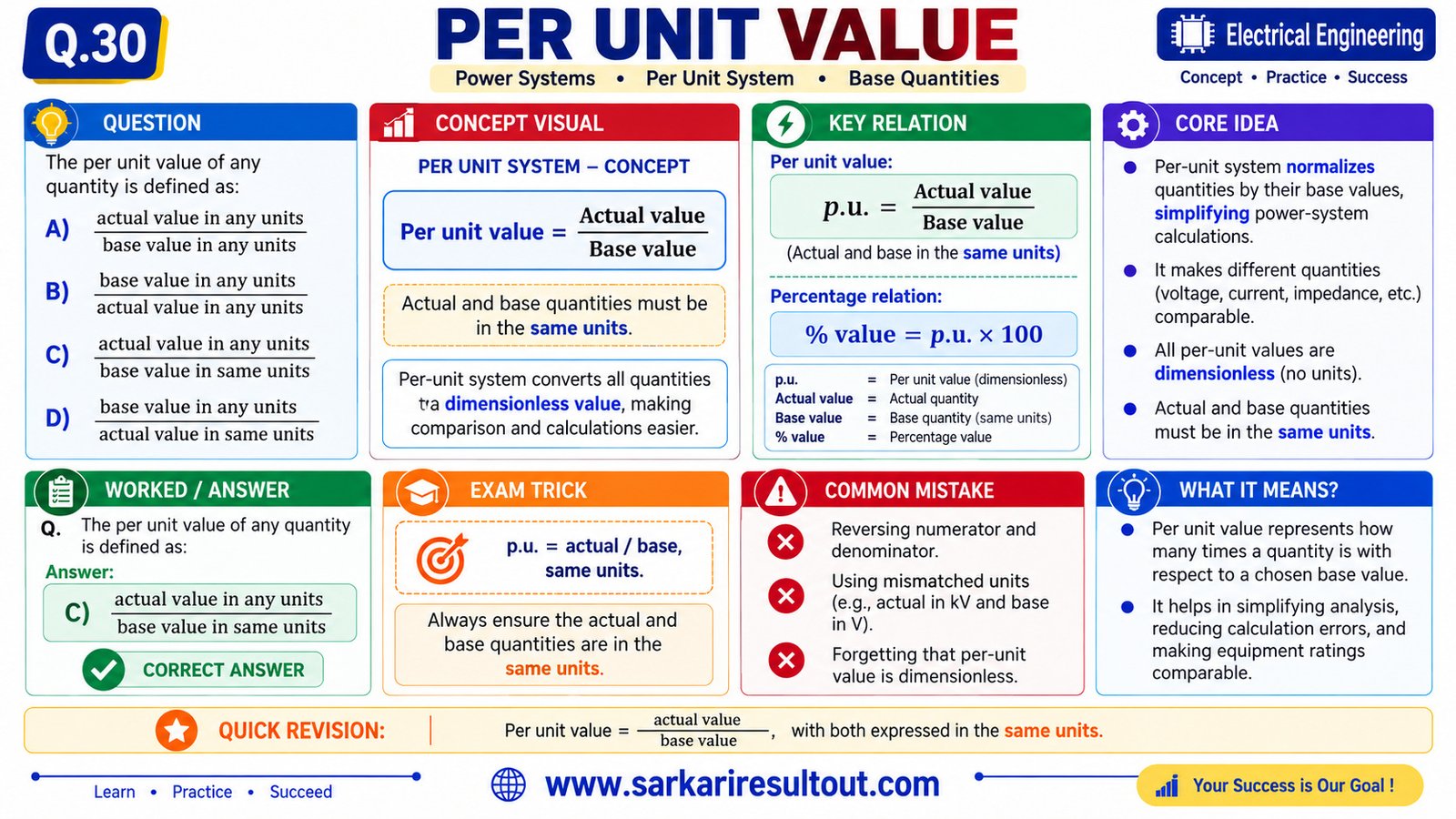
The per unit value of any quantity is defined as:
 Answer & step-by-step solution

C — Actual value divided by base value in the same units. The units cancel, making the per-unit quantity dimensionless.
Correct answer: C — actual value in any units / base value in same units
Definition of a per-unit quantity
The per-unit system expresses a quantity relative to a selected reference or base value of the same physical quantity. It is defined as:
x_pu = x_actual/x_base
Voltage is divided by base voltage, current by base current, and impedance by base impedance. Both values must be expressed in the same units before division. Their units then cancel, leaving a dimensionless ratio.
Example with unit conversion
Step 1: Choose the actual and base values. Suppose the actual voltage is 5,500 V and the selected base voltage is 11 kV.
Step 2: Express both in the same unit. Convert the base voltage: 11 kV = 11,000 V.
Step 3: Divide actual value by base value. The normalized voltage is:
V_pu = 5,500/11,000 = 0.5 pu
Percentage value = 100 × 0.5 = 50%
A value of 1 pu means actual equals base, 0.5 pu means half the base, and 1.1 pu means 10% above the base. The same actual quantity can have different per-unit values on different bases, so the chosen base must be stated when interpreting or comparing results. This definition directly matches option C .
Quick Trick
PU = Actual / Base, same quantity, same units.
Why Other Options Are Wrong
A says ‘any units’ for both numerator and denominator without requiring consistency, so units may not cancel. B and D invert the required ratio. C correctly states actual/base in the same units.
Common Mistake
Mixing units such as volts and kilovolts without converting them consistently before forming the ratio.

किसी भी राशि का प्रति इकाई (per unit) मान इस प्रकार परिभाषित है:
उत्तर और चरणबद्ध हल
C — वास्तविक मान ÷ उसी इकाई में आधार मान। इकाइयाँ कट जाती हैं, इसलिए प्रति-इकाई राशि विमाहीन होती है।
विस्तृत हल (मूल भाषा में)
Correct answer: C — actual value in any units / base value in same units
Definition of a per-unit quantity
The per-unit system expresses a quantity relative to a selected reference or base value of the same physical quantity. It is defined as:
x_pu = x_actual/x_base
Voltage is divided by base voltage, current by base current, and impedance by base impedance. Both values must be expressed in the same units before division. Their units then cancel, leaving a dimensionless ratio.
Example with unit conversion
Step 1: Choose the actual and base values. Suppose the actual voltage is 5,500 V and the selected base voltage is 11 kV.
Step 2: Express both in the same unit. Convert the base voltage: 11 kV = 11,000 V.
Step 3: Divide actual value by base value. The normalized voltage is:
V_pu = 5,500/11,000 = 0.5 pu
Percentage value = 100 × 0.5 = 50%
A value of 1 pu means actual equals base, 0.5 pu means half the base, and 1.1 pu means 10% above the base. The same actual quantity can have different per-unit values on different bases, so the chosen base must be stated when interpreting or comparing results. This definition directly matches option C .
Quick Trick
PU = Actual / Base, same quantity, same units.
Why Other Options Are Wrong
A says ‘any units’ for both numerator and denominator without requiring consistency, so units may not cancel. B and D invert the required ratio. C correctly states actual/base in the same units.
Common Mistake
Mixing units such as volts and kilovolts without converting them consistently before forming the ratio.
કોઈ પણ રાશિનું એકમ દીઠ (per unit) મૂલ્ય આ રીતે વ્યાખ્યાયિત છે:
જવાબ અને પગલાવાર ઉકેલ
C — વાસ્તવિક મૂલ્ય ÷ એ જ એકમમાં આધાર મૂલ્ય. એકમો રદ થાય છે, તેથી એકમ-દીઠ રાશિ પરિમાણરહિત બને છે.
વિગતવાર ઉકેલ (મૂળ ભાષામાં)
Correct answer: C — actual value in any units / base value in same units
Definition of a per-unit quantity
The per-unit system expresses a quantity relative to a selected reference or base value of the same physical quantity. It is defined as:
x_pu = x_actual/x_base
Voltage is divided by base voltage, current by base current, and impedance by base impedance. Both values must be expressed in the same units before division. Their units then cancel, leaving a dimensionless ratio.
Example with unit conversion
Step 1: Choose the actual and base values. Suppose the actual voltage is 5,500 V and the selected base voltage is 11 kV.
Step 2: Express both in the same unit. Convert the base voltage: 11 kV = 11,000 V.
Step 3: Divide actual value by base value. The normalized voltage is:
V_pu = 5,500/11,000 = 0.5 pu
Percentage value = 100 × 0.5 = 50%
A value of 1 pu means actual equals base, 0.5 pu means half the base, and 1.1 pu means 10% above the base. The same actual quantity can have different per-unit values on different bases, so the chosen base must be stated when interpreting or comparing results. This definition directly matches option C .
Quick Trick
PU = Actual / Base, same quantity, same units.
Why Other Options Are Wrong
A says ‘any units’ for both numerator and denominator without requiring consistency, so units may not cancel. B and D invert the required ratio. C correctly states actual/base in the same units.
Common Mistake
Mixing units such as volts and kilovolts without converting them consistently before forming the ratio.
 More Per-Unit System questions