
New Gratuity Rules: The Government of India has implemented major changes to gratuity rules under the new labour codes starting November 2025. Here’s what workers and employers need to know:
What Is Gratuity, and Why Is This Change Important?
Gratuity is a lump-sum payment made by an employer to an employee as a token of appreciation for the service rendered by the workers towards the organization. Historically, under the old Payment of Gratuity Act, an employee needed to complete five years of continuous service in a particular organization before becoming eligible for his or her gratuity. This effectively excluded most workers on fixed-term contracts, as their employment typically didn’t last that long for the organization.
Key Highlights of New Gratuity Rules
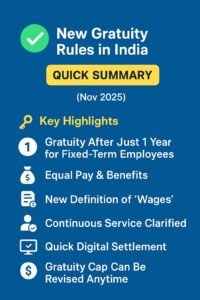
Gratuity After Just 1 Year for Fixed-Term Employees
-
Fixed-term employees no longer need 5 years to qualify for Gratuity.
-
Eligibility begins after 1 year of continuous service in particular organization.
Equal Pay & Benefits
-
Fixed-term workers must receive the same pay structure as permanent employees.
-
Includes wages, leave, social security, medical benefits, etc.
New Definition of “Wages”
-
Gratuity now calculated using a broader wage base (basic + DA + certain allowances).
-
Prevents underpayment through salary restructuring.
Continuous Service Clarified
Counted as continuous service even if breaks were due to:
-
Sickness
-
Maternity leave
-
Accidents
-
Strikes/lockouts
-
Temporary closure
Quick Digital Settlement
-
Claims will be filed and processed through a central digital portal.
-
Employers must settle gratuity within specified deadlines.
Gratuity Cap Can Be Revised Anytime
-
Government can revise the maximum gratuity limit without passing a new law.
Why This Matters for Workers
-
More workers become eligible for gratuity—especially contract and project-based staff.
-
Larger and fairer gratuity payouts due to new wage rules.
-
Stronger financial support after employment ends.
-
Greater parity between permanent and fixed-term employees.
Who Benefits Most?
-
IT & Tech project staff
-
Manufacturing contract workers
-
Media & creative industry freelancers
-
EdTech and startup employees
-
Gig and short-term professionals