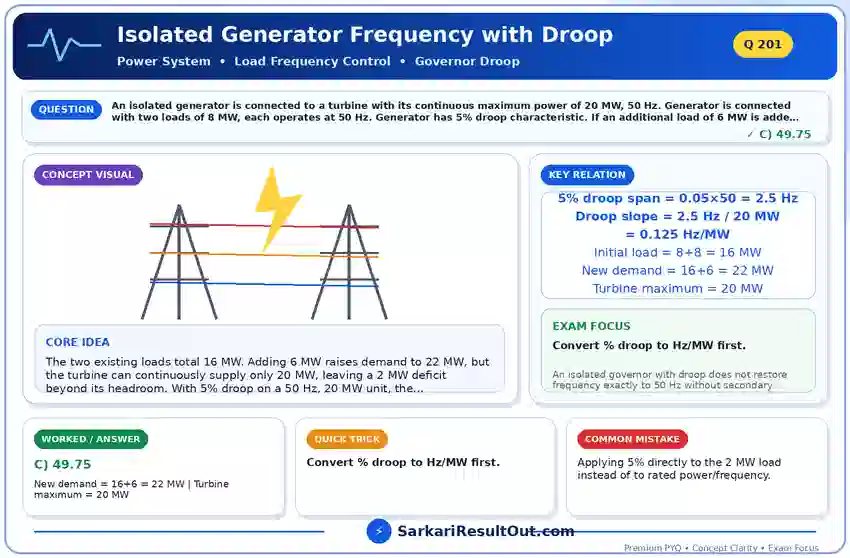
An isolated generator is connected to a turbine with its continuous maximum power of 20 MW, 50 Hz. Generator is connected with two loads of 8 MW, each operates at 50 Hz. Generator has 5% droop characteristic. If an additional load of 6 MW is added, then frequency will be ___________
⚑ Report issue
Found a wrong answer, translation, image or source problem? Send it to editorial review.
The two existing loads total 16 MW. Adding 6 MW raises demand to 22 MW, but the turbine can continuously supply only 20 MW, leaving a 2 MW deficit beyond its headroom. With 5% droop on a 50 Hz, 20 MW unit, the frequency-power slope is 0.125 Hz/MW; the exam's steady-state simplification therefore gives a 0.25 Hz drop to 49.75 Hz.
Formula / Key Relation
5% droop span = 0.05×50 = 2.5 Hz
Droop slope = 2.5 Hz / 20 MW
= 0.125 Hz/MW
Initial load = 8+8 = 16 MW
New demand = 16+6 = 22 MW
Turbine maximum = 20 MW
Unserved increment beyond headroom = 2 MW
Δf = 0.125×2 = 0.25 Hz
f ≈ 50−0.25 = 49.75 Hz
Detailed Explanation
Concept & ReasoningFive-percent droop corresponds to a 2.5 Hz frequency change for a 20 MW full-range power change, so the slope is 2.5/20=0.125 Hz/MW. The machine is initially supplying 8+8=16 MW and has only 4 MW continuous headroom to its 20 MW turbine limit. A 6 MW added demand exceeds that headroom by 2 MW. Applying the exam's droop/shortfall convention gives Δf=0.125×2=0.25 Hz and f≈49.75 Hz. In a real isolated system, a fully saturated prime mover requires load-frequency dependence or load shedding for a true steady-state balance; that practical nuance is not specified in the MCQ.How to Solve It in…
Concept & Reasoning
Five-percent droop corresponds to a 2.5 Hz frequency change for a 20 MW full-range power change, so the slope is 2.5/20=0.125 Hz/MW. The machine is initially supplying 8+8=16 MW and has only 4 MW continuous headroom to its 20 MW turbine limit. A 6 MW added demand exceeds that headroom by 2 MW. Applying the exam's droop/shortfall convention gives Δf=0.125×2=0.25 Hz and f≈49.75 Hz. In a real isolated system, a fully saturated prime mover requires load-frequency dependence or load shedding for a true steady-state balance; that practical nuance is not specified in the MCQ.
How to Solve It in the Exam
Convert % droop to Hz/MW first.
Important Exam Point
An isolated governor with droop does not restore frequency exactly to 50 Hz without secondary control.
Editorial / Answer-Key Note
The official GPSC final answer key revised the provisional outcome for this question from D to C.
Related Revision Path
This question sits in the revision path Power System → Load Frequency Control → Governor Droop .
Quick Trick
Convert % droop to Hz/MW first.
Common Mistake
Applying 5% directly to the 2 MW load instead of to rated power/frequency.
Exam Tip
An isolated governor with droop does not restore frequency exactly to 50 Hz without secondary control.
SEO + Knowledge GraphRelated PYQs & Exam ContextExam path, knowledge path and deeper practice links.
Assistant Engineer (Electrical), Class-2, Road and Building Department2025Q. 201Assistant Engineer (Electrical), Class-2, Road and Building Department2025Q. 201Assistant Engineer (Electrical), Class-2, Road and Building Department2025Q. 201Assistant Engineer (Electrical), Class-2, Road and Building Department2025Q. 201Assistant Engineer (Electrical), Class-2, Road and Building Department2025Q. 201Assistant Engineer (Electrical), Class-2, Road and Building Department2025Q. 201Assistant Engineer (Electrical), Class-2, Road and Building Department2025Q. 201Assistant Engineer (Electrical), Class-2, Road and Building Department2025Q. 201Assistant Engineer (Electrical), Class-2, Road and Building Department2025Q. 201Assistant Engineer (Electrical), Class-2, Road and Building Department2025Q. 201