Previous Year Question
Correct answer: B
Explanation
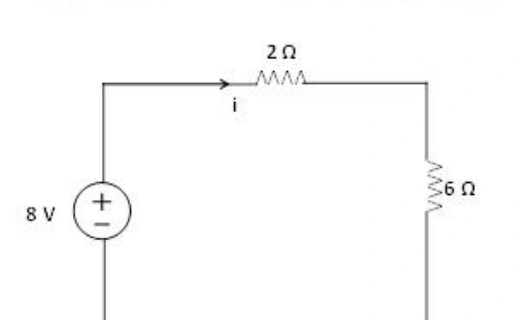
B — 1 A. The 2 Ω and 6 Ω resistors are in series, so the 8 V source drives 8/(2 + 6) = 1 A.
Formula
Step-by-step solution
Correct answer: B — 1 A
Read the circuit connection
The figure shows an 8 V source, a 2 Ω resistor and a 6 Ω resistor in one closed loop. There is no branch at which the current can divide, so both resistors carry the same current I. They are therefore connected in series.
Step 1: Find the total resistance. Series resistances add:
Step 2: Apply Ohm’s law to the complete loop. Use the source voltage across the total resistance:
Step 3: State the result and direction. The source’s positive terminal is at the top. Conventional current passes through the 2 Ω resistor from left to right, matching the arrow shown. Hence I = 1 A, option B.
The source voltage is shared by the two resistors: the 2 Ω resistor has a 2 V drop and the 6 Ω resistor has a 6 V drop. Each resistor carries 1 A; each does not receive the full 8 V. This distinction between equal series current and divided voltage is the essential circuit concept.
Other options
6 A, 2 A and 8 A would produce total resistor drops of 48 V, 16 V and 64 V respectively across the 8 Ω series combination, which cannot match the 8 V source. Only 1 A satisfies KVL.
Common mistake
Using only the 2 Ω or only the 6 Ω resistor when computing current instead of adding both series resistances.
Exam tip
One loop, no branches → series resistance first, then one Ohm’s-law step.
Quick method
2+6=8 Ω and source is 8 V → current is immediately 1 A.