Previous Year Question
Correct answer: A
Explanation
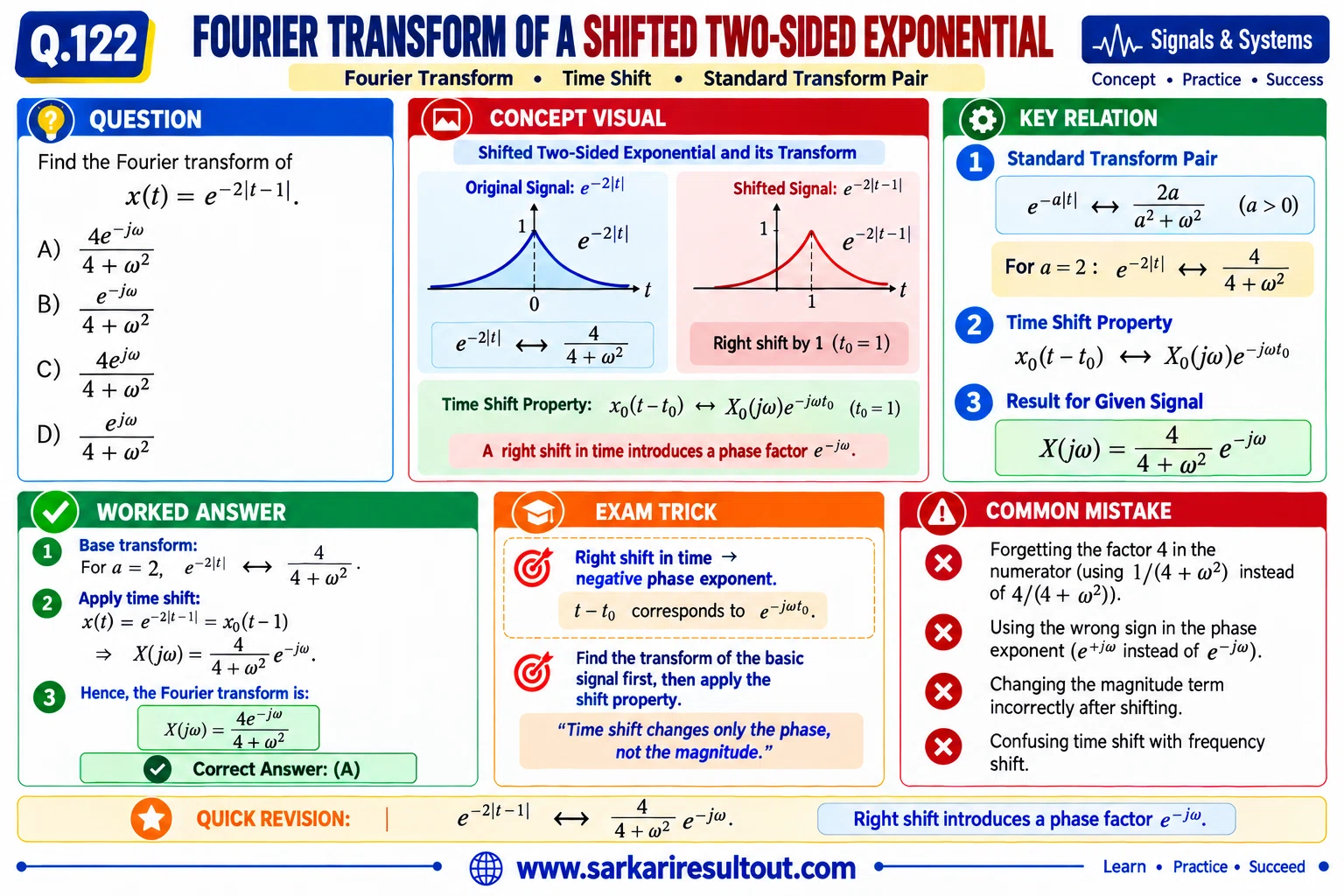
Use the pair e^{-a|t|}↔2a/(a²+ω²). For a=2 the base transform is 4/(4+ω²). Replacing t by t−1 shifts the signal right by 1 s and multiplies the spectrum by e^{-jω}. Thus X(jω)=4e^{-jω}/(4+ω²), option A.
Formula
Step-by-step solution
Correct Answer
A — 4e^(−jω)/(4 + ω²)
Concept and Reasoning
Use the pair e^{-a|t|}↔2a/(a²+ω²). For a=2 the base transform is 4/(4+ω²). Replacing t by t−1 shifts the signal right by 1 s and multiplies the spectrum by e^{-jω}. Thus X(jω)=4e^{-jω}/(4+ω²), option A.
Calculation / Key Relation
e^{-2|t−1|} ↔ 4e^{-jω}/(4+ω²)
Exam Takeaway
Right time shift → negative spectral phase factor e^{-jωt0}.
Common Mistake
Do not change the magnitude denominator because of the time shift.
Common mistake
Do not change the magnitude denominator because of the time shift.
Exam tip
Right time shift → negative spectral phase factor e^{-jωt0}.
Quick method
Right time shift → negative spectral phase factor e^{-jωt0}.