Previous Year Question
Correct answer: A
Explanation
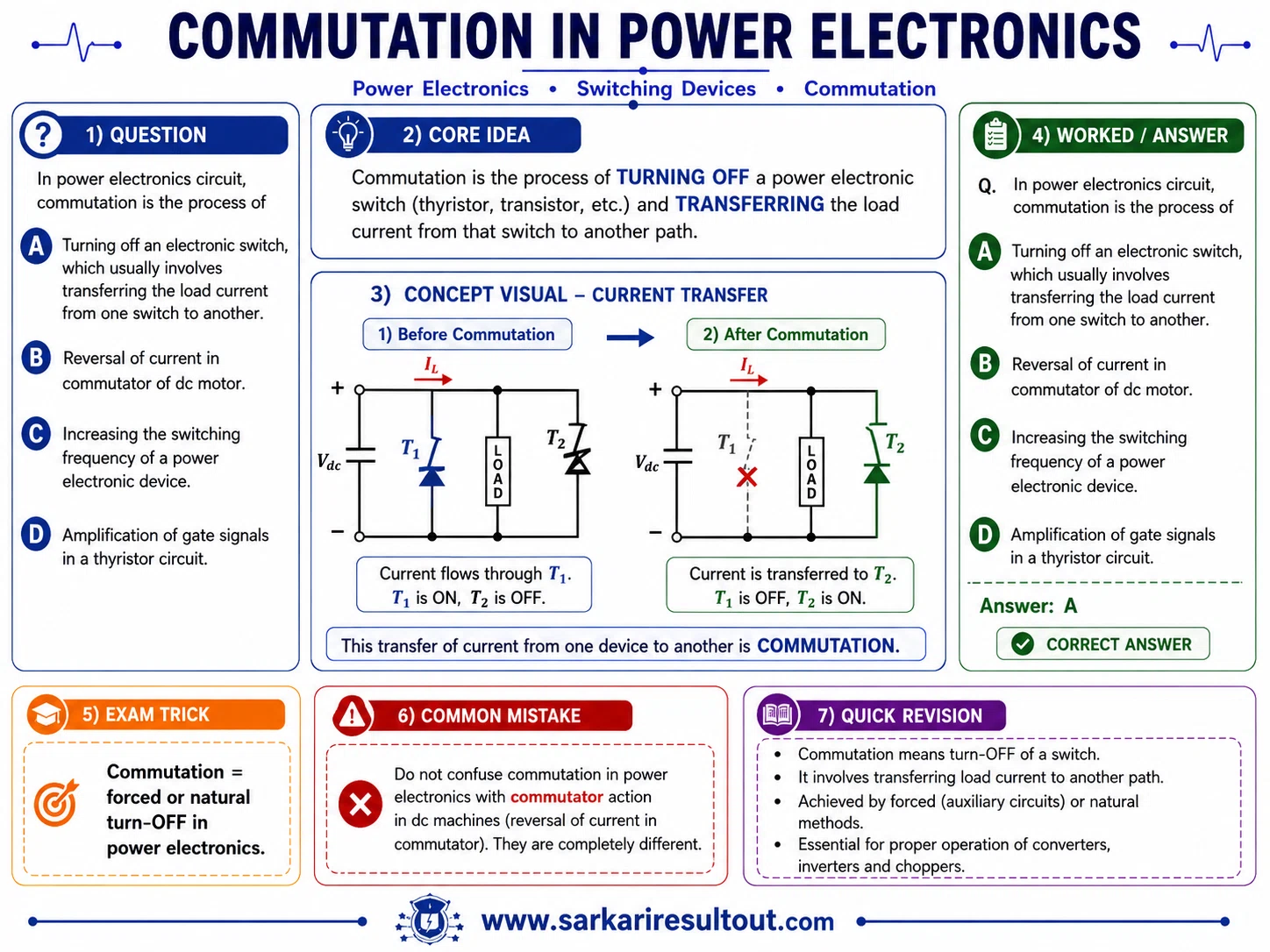
Commutation is the process of transferring current away from a conducting power semiconductor so that its current falls below the required holding value and the device turns off. In line-commutated circuits the AC source provides this naturally; in forced commutation an auxiliary network produces the required current/voltage condition.
Formula
Step-by-step solution
Correct Answer
A — Turning off an electronic switch, which usually involves transferring the load current from one switch to another.
Concept and Reasoning
Commutation is the process of transferring current away from a conducting power semiconductor so that its current falls below the required holding value and the device turns off. In line-commutated circuits the AC source provides this naturally; in forced commutation an auxiliary network produces the required current/voltage condition.
Calculation / Key Relation
SCR turn-off condition: iA < IH for at least the turn-off time tq
Exam Takeaway
Commutation is fundamentally a current-transfer/turn-off process.
Common Mistake
Do not confuse commutation with gate triggering, which initiates conduction.
Common mistake
Do not confuse commutation with gate triggering, which initiates conduction.
Exam tip
Commutation is fundamentally a current-transfer/turn-off process.
Quick method
Commutation is fundamentally a current-transfer/turn-off process.