Previous Year Question
Correct answer: B
Explanation
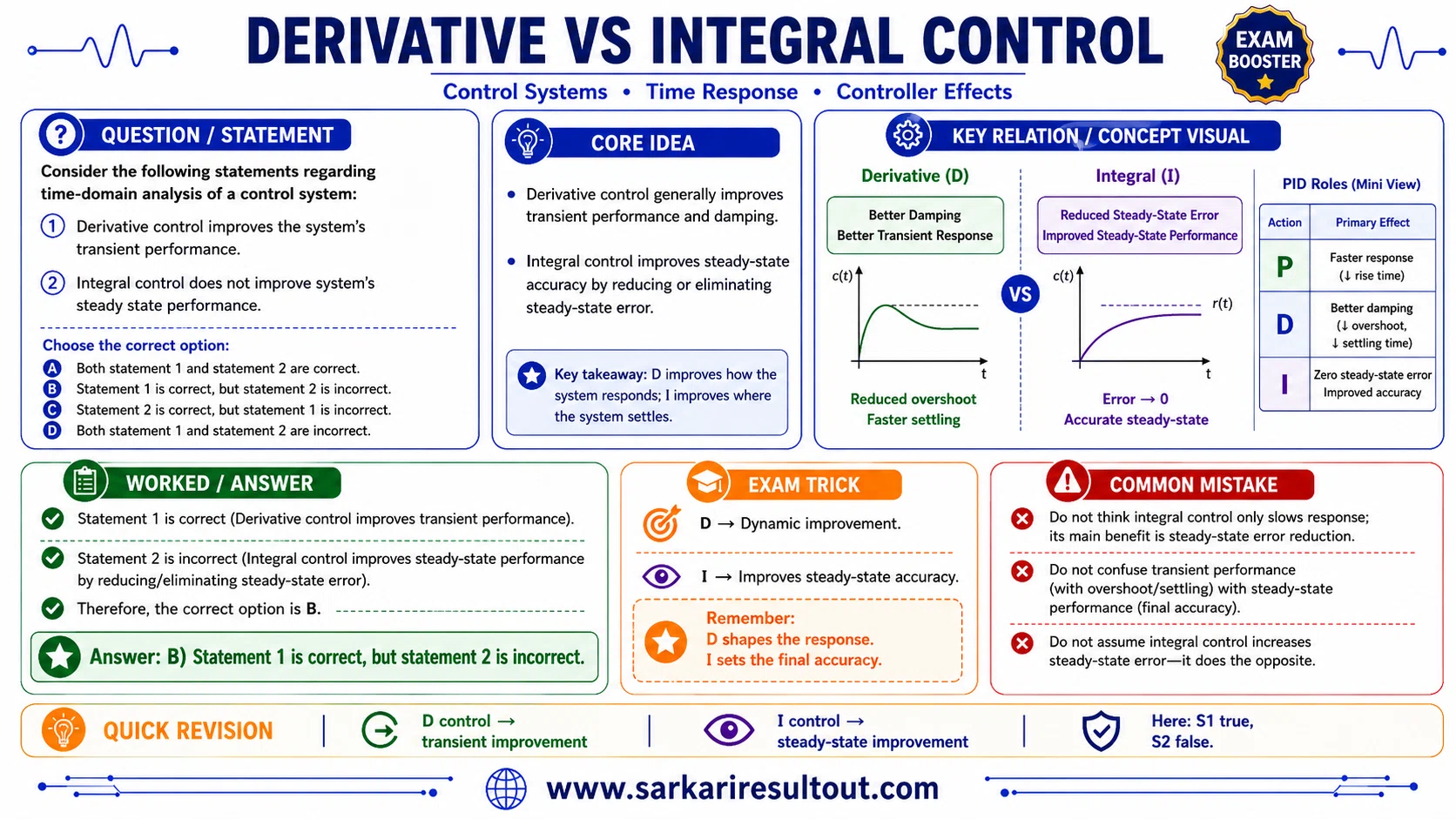
Derivative action anticipates changes in error and generally improves damping and transient response. Integral action accumulates error and is specifically used to improve steady-state accuracy, often eliminating step steady-state error. Hence statement 1 is true and statement 2 is false.
Formula
Step-by-step solution
Correct Answer
B — Statement 1 is correct, but statement 2 is incorrect.
Statement-wise Analysis
Statement 1: True
Statement 2: False
Concept and Reasoning
Derivative action anticipates changes in error and generally improves damping and transient response. Integral action accumulates error and is specifically used to improve steady-state accuracy, often eliminating step steady-state error. Hence statement 1 is true and statement 2 is false.
Calculation / Key Relation
PID: u=Kp e+Ki∫e dt+Kd de/dt
Exam Takeaway
D → transient/damping; I → steady-state accuracy.
Common Mistake
Do not say integral control has no steady-state benefit.
Common mistake
Do not say integral control has no steady-state benefit.
Exam tip
D → transient/damping; I → steady-state accuracy.
Quick method
D → transient/damping; I → steady-state accuracy.